
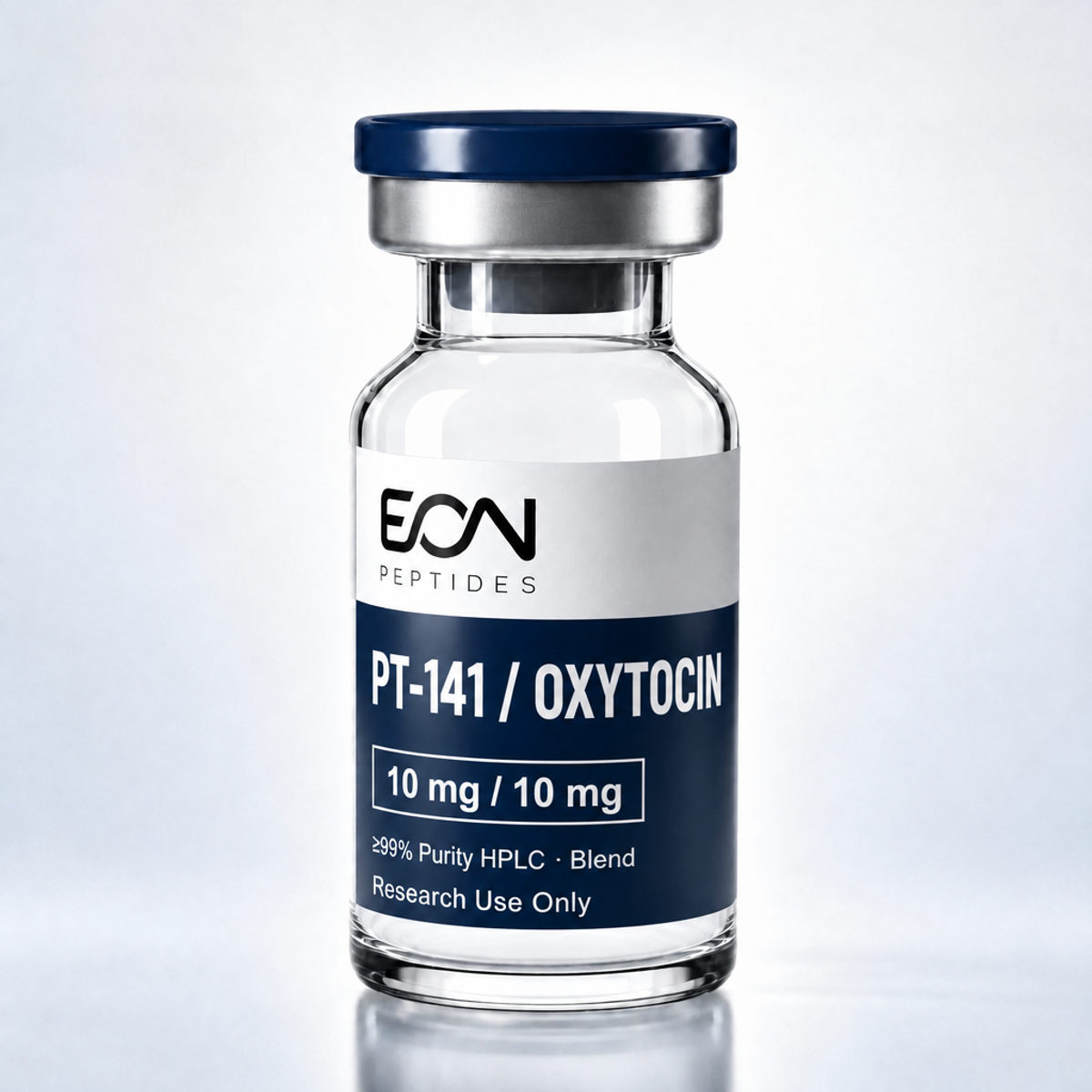
Molecular data
| Physical form | Lyophilized powder blend |
|---|---|
| Available sizes | 10mg / 10mg |
How it works
-
PT-141
Melanocortin Receptors
PT-141 is a cyclic heptapeptide that binds MC3R and MC4R. Research has measured its activity in the central nervous system rather than in blood vessels, which separates it from other compounds studied in the same area. Its structure derives from Melanotan II.
- Cyclic seven amino acid structure
- MC3R and MC4R binding
- Central rather than vascular activity
-
Oxytocin
OXTR Binding
Oxytocin is a nine amino acid neurohypophysial hormone closed by a disulfide bridge between residues 1 and 6. It binds the oxytocin receptor OXTR, and social and affiliative behaviour endpoints have been measured in animal models.
- Nonapeptide with 1-6 disulfide
- OXTR agonist
- Behavioural endpoints in animal models
-
Combined
Two Receptor Systems
The vial pairs a melanocortin agonist with a neurohypophysial hormone. The receptors are unrelated, the two are characterised separately, and no interaction data exists for the pair.
- Unrelated receptor systems
- Matched handling
- Interaction not characterised
What the research shows
-
Neuro
Melanocortin Signalling
PT-141 is characterised for MC3R and MC4R activity in central nervous system models.
-
Endocrine
Neurohormone Studies
Oxytocin is a long-established reference ligand for the OXTR receptor.
-
Neuro
Receptor Pharmacology
Both peptides are used as receptor-defined tools in binding and signalling assays.
-
Methods
Parallel Protocols
One vial holds both peptides under matched handling.
Specification
| Components | PT-141 + Oxytocin |
|---|---|
| Content | 20 mg per vial (10 mg of each component) |
| PT-141 | Ac-Nle-cyclo[Asp-His-D-Phe-Arg-Trp-Lys]-OH (bremelanotide) |
| Oxytocin | Cys-Tyr-Ile-Gln-Asn-Cys-Pro-Leu-Gly-NH₂, CAS 50-56-6 |
| Form | Lyophilized powder blend |
| Purity | ≥99% by HPLC |
| Appearance | White to off-white powder |
| Solubility | Water-soluble |
| Storage | -20°C, protected from light |
| Classification | Research use only |
Frequently asked questions
Why combine PT-141 and Oxytocin?
Both are central nervous system signalling peptides studied in neuroendocrine research, though at unrelated receptors: PT-141 at MC3R and MC4R, Oxytocin at OXTR. One vial holds both under matched handling.
Do the two peptides share a receptor?
No. The melanocortin receptors and the oxytocin receptor are distinct receptor systems, and no interaction between the two has been characterised.
Has the combination been characterised as a single formulation?
No. Each peptide is characterised separately and no interaction data exists for the pair.
How does this differ from buying PT-141 separately?
The standalone PT-141 product lets you control its quantity independently and is offered in its own size. This vial fixes the ratio at 10 mg and 10 mg and adds Oxytocin.
What purity is documented?
Each lot is analysed by reverse-phase HPLC and released at ≥99%, with a Certificate of Analysis.
How is it stored?
Store lyophilized at -20°C for long-term stability, protected from light and moisture, and avoid repeated freeze-thaw cycles.
Related monographs
For laboratory research use only. Not a drug, supplement, or medical product; not for human or animal use. All findings referenced are from published preclinical/laboratory research.