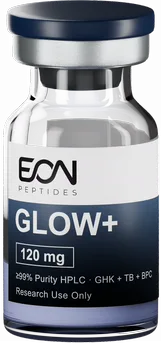
Dermal Models
Collagen, elastin and glycosaminoglycan synthesis measured in fibroblast culture. Studied extensively in wound-closure and dermal-ageing models.


Collagen Synthesis Studies
Free Shipping on orders over $200
Scan the QR code on any vial to verify its batch, COA, and origin in seconds. Secure traceability from our lab to your bench.
Researchers also added
Research use only.
The Eon standard
Your results are only as good as your compound.
Every lot of GHK-Cu is tested by an independent ISO/IEC 17025-accredited lab in the USA. 99%+ purity isn't a target here. It's the requirement.
Don't take our word for it: test any vial at an accredited lab of your choice. If HPLC purity comes back under 99%, we refund your order and pay for the test.
GHK-Cu is a copper peptide made of three amino acids. It occurs naturally and was first isolated from human plasma in 1973. It is among the more extensively characterised peptides in dermal research. Studies have measured how much collagen skin cells produce after exposure, and how the surrounding tissue structure changes. Levels in plasma fall with age, and that finding is what drove most of the research that followed.
Copper-binding tripeptide
The numbers that define GHK-Cu and how it is being studied. For laboratory research use only.
Up- or down-regulated in human cell lines
Gly-His-Lys tripeptide carrying a copper(II) ion
About 200 ng/mL at age 20, 80 ng/mL by age 60
The pathways GHK-Cu acts on - and what each one does. The animation traces its signal outward from the compound to every target it engages.
GHK-Cu chelates copper(II) ions and delivers them to cells. Copper-dependent enzymes involved in collagen crosslinking, antioxidant activity and tissue remodelling have been measured following exposure.
Fibroblast production of type I and III collagen, glycosaminoglycans and decorin has been measured in culture, alongside changes in extracellular matrix architecture.
Gene expression work reports changes across 4,000+ human genes following GHK-Cu exposure - among the broadest transcriptional footprints recorded for a short peptide.
The main areas GHK-Cu is being studied for - and the study-reported figures behind them.
Collagen, elastin and glycosaminoglycan synthesis measured in fibroblast culture. Studied extensively in wound-closure and dermal-ageing models.
Associated with larger follicle size, follicle growth and hair-cycle transition in preclinical models.
Expression changes reported across 4,000+ genes, including DNA repair, antioxidant and inflammatory pathways.
Chelates free copper, with lower oxidative-damage markers and raised superoxide dismutase activity measured in the same systems.
An interactive 3D model rendered from the compound record - rotate and explore its structure.
Copper-coordination complex
| Sequence | Gly-His-Lys-Cu(II) |
| Molecular Weight | 403.9 Da |
| Molecular Formula | C₁₄H₂₄CuN₆O₄ |
| Form | Lyophilized powder |
| Purity | ≥99% (HPLC verified) |
| Testing | Third-party HPLC, Mass Spec, Endotoxin |
| Storage | -20°C for up to 24 months |
| Solubility | Water-soluble |
| COA | Included with every order |
GHK-Cu (glycyl-L-histidyl-L-lysine copper) is a naturally occurring copper-binding tripeptide first isolated from human plasma in 1973 by Dr. Loren Pickart. It is found in human blood, saliva, and urine, with plasma levels declining from approximately 200 ng/mL at age 20 to 80 ng/mL by age 60.
Preclinical research has studied GHK-Cu in wound-closure and dermal models, including collagen and glycosaminoglycan synthesis; recruitment of immune and endothelial cells to injury sites; anti-inflammatory and antioxidant activity; and expression changes across over 4,000 genes.
GHK-Cu is not FDA approved as a drug. It is available as a research peptide and is also found in some cosmetic formulations. The lyophilized material sold here is for in vitro research purposes only.
GHK-Cu has been studied in cultured cell systems and in animal models, with copper binding, collagen-related gene expression and tissue-remodelling endpoints. Concentrations and endpoints differ between experiments.
GHK-Cu consists of three amino acids - glycine, histidine, and lysine - complexed with a copper(II) ion. The molecular formula is C₁₄H₂₄CuN₆O₄ with a molecular weight of approximately 403.9 Da. The histidine residue provides the primary copper-binding site.
Lyophilized GHK-Cu should be stored at -20°C for maximum stability (up to 24 months). Avoid repeated freeze-thaw cycles and protect from light.
Not for human or veterinary use. For in-vitro laboratory research only. These statements have not been evaluated by the FDA; this product is not intended to diagnose, treat, cure, or prevent any disease. Sold exclusively to qualified researchers and institutions.