
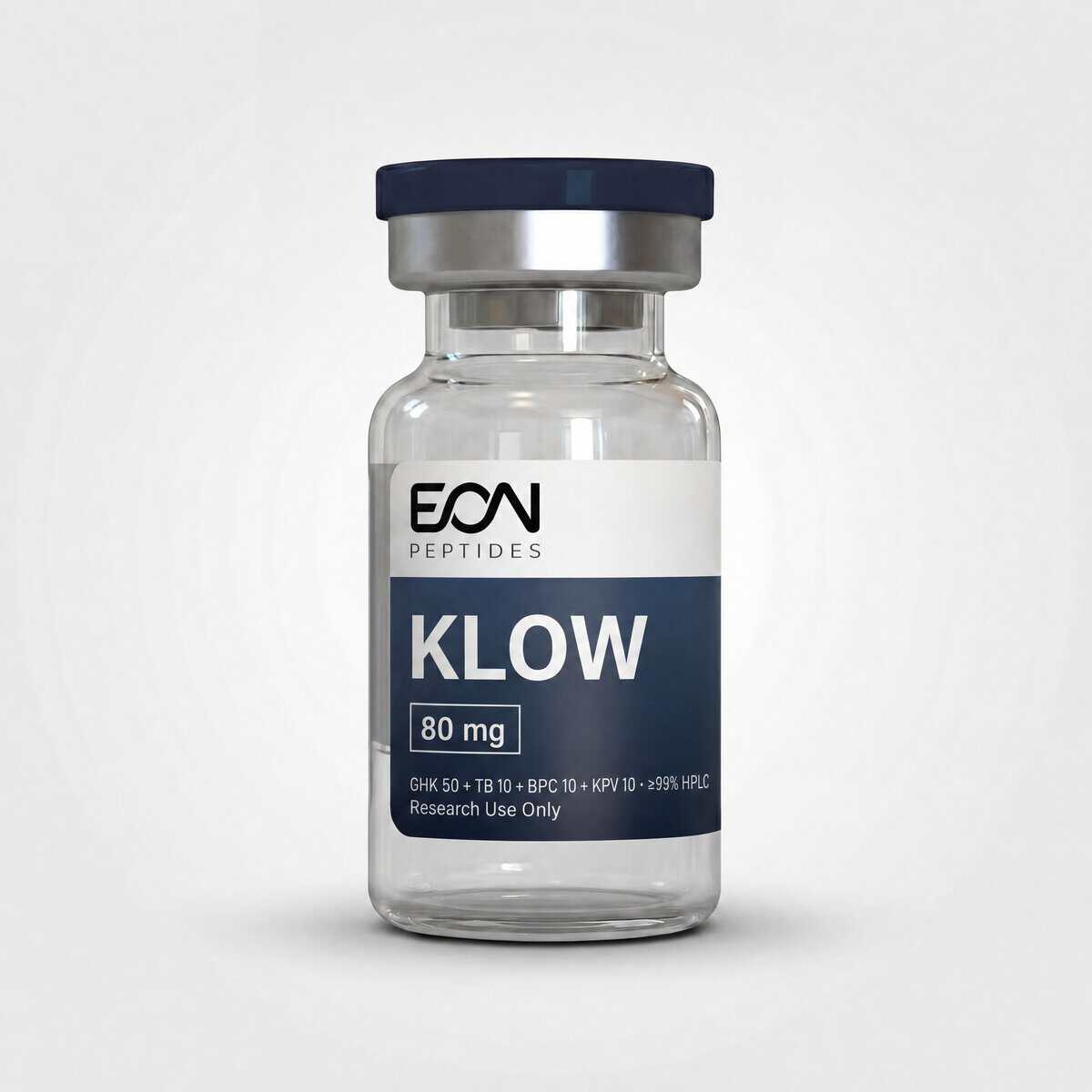
Molecular data
| Molecular formula | Mixture (GHK-Cu + TB-500 + BPC-157 + KPV) |
|---|---|
| Sequence | Components: GHK-Cu (Gly-His-Lys + Cu2+); TB-500 (Ac-LKKTETQ); BPC-157 (GEPPPGKPADDAGLV); KPV (Lys-Pro-Val) |
| Physical form | Lyophilized powder |
| Available sizes | 80mg |
How it works
-
BPC-157 and TB-500
Angiogenic and Growth-Factor Pathways
Preclinical studies of BPC-157 in bone, muscle, tendon and skin models describe upregulated growth factors alongside angiogenic signalling. TB-500, a fragment of thymosin β-4, appears in several animal models where fibrotic endpoints and the migration of cells are the measured outcomes.
- Animal-model reports for BPC-157 cover angiogenesis and upregulated growth factors
- TB-500 binds actin; culture assays quantify the resulting cell migration
- Dermal, cardiac, muscle and tendon injury models feature in the literature on both
-
GHK-Cu
Collagen and the Extracellular Matrix
A tripeptide that binds copper, GHK-Cu serves widely as a reference compound for extracellular-matrix research. That status rests on cell-culture measurements taken after exposure: fibroblast migration, endothelial activity, and the synthesis of elastin and collagen.
- Fibroblast models used to examine elastin and collagen synthesis
- Culture-based readouts of fibroblast and endothelial activity
- Appears in dermal and extracellular-matrix model work
-
KPV
Modulation of Inflammatory Signalling
KPV corresponds to the three C-terminal residues of α-MSH. At nanomolar concentrations, in vitro studies describe dampened MAP-kinase and NF-κB signalling, and the same assays show cytokine output falling in step.
- In vitro reports describe lowered MAP-kinase and NF-κB signalling
- Research models record reduced IL-1β, IL-6 and TNF-α
- Contributes the blend's cytokine-signalling element
What the research shows
-
Musculoskeletal Models
Connective Tissue, Tendon and Muscle Studies
Preclinical bone, muscle and tendon models are where BPC-157 and peptides of related structure are examined. Data from humans remain sparse.
-
Cellular Assays
Angiogenesis and Migration of Cells
Ex-vivo and in-vitro systems often pair GHK-Cu, TB-500 and BPC-157 so that matrix gene expression and endothelial activity can be probed together.
-
Dermal Research
Wound, Collagen and Skin Models
In fibroblast culture GHK-Cu is the reference compound for elastin and collagen synthesis; the blend itself is examined in dermal models.
-
Class Pharmacology
Pharmacology of the Peptide Class
Signalling mechanisms are what define this class of peptides; for each of the four components, evidence from humans is still limited.
How it's tested
Every lot of KLOW released to the catalog carries a third-party certificate of analysis. 6 documented lots are on file for this compound, with reported HPLC purity from 99.61% to 99.84% (mean 99.74%), issued by Accurate Test Labs and Freedom Diagnostics. 4 of 6 certificates record identity as confirmed.
- Documented lots
- 6
- Reported purity
- 99.61% to 99.84%
- Mean purity
- 99.74%
- Issuing labs
- Accurate Test Labs, Freedom Diagnostics
- 2026-09-03 Lot KL-090226-80Accurate Test Labs 99.73% View certificate
- 2026-08-20 Lot RXY8XMAccurate Test Labs 99.77% View certificate
- 2026-08-03 Lot S7UDXNAccurate Test Labs 99.84% View certificate
Frequently asked questions
How is the KLOW blend composed and classified?
KLOW is classified as a research blend of four peptides. Each vial holds 80 mg of peptide in total: 50 mg GHK-Cu, 10 mg TB-500, 10 mg BPC-157 and 10 mg KPV. All are short peptides, each with its own literature in cytokine-signalling, cell-migration or matrix research.
Which research areas characterise each KLOW component?
GHK-Cu belongs to fibroblast and collagen-synthesis models, while KPV is examined in models of NF-κB signalling. TB-500, derived from thymosin β-4 as a fragment, appears in fibrosis and cell-migration models, and BPC-157 in bone, muscle and tendon models through growth-factor signalling. Together the four cover cytokine, matrix, angiogenic and growth-factor pathways.
What is the scientific rationale for a four-peptide preparation?
The mechanisms differ from component to component. GHK-Cu relates to the extracellular matrix, KPV to cytokine signalling, and BPC-157 with TB-500 to growth-factor and angiogenic signalling. A single preparation therefore engages several pathways together, and that is the reason blends serve in experiments comparing single-compound conditions against multi-pathway ones.
What is the regulatory standing of the KLOW components?
No component of KLOW holds FDA drug approval. For BPC-157 in particular, neither the EMA nor the FDA has granted approval, and in the United States a Category 2 designation issued by the FDA in 2023 restricts its compounding. KLOW of research grade is provided solely for laboratory research in vitro.
In which experimental systems are these peptides studied?
Animal models, tissue explants studied ex vivo and in-vitro systems all make use of GHK-Cu, TB-500 and BPC-157. Typical endpoints include wound closure, migration of cells, matrix gene expression in fibroblasts and endothelial-cell activity within angiogenesis assays. Inflammatory-signalling research is where KPV is applied. For the blend itself, human data do not exist.
What storage conditions preserve lyophilized KLOW?
To keep all four peptides intact, KLOW in lyophilized form is held at -20°C and shielded from moisture and light.
Related monographs
For laboratory research use only. Not a drug, supplement, or medical product; not for human or animal use. All findings referenced are from published preclinical/laboratory research.