Molecular data
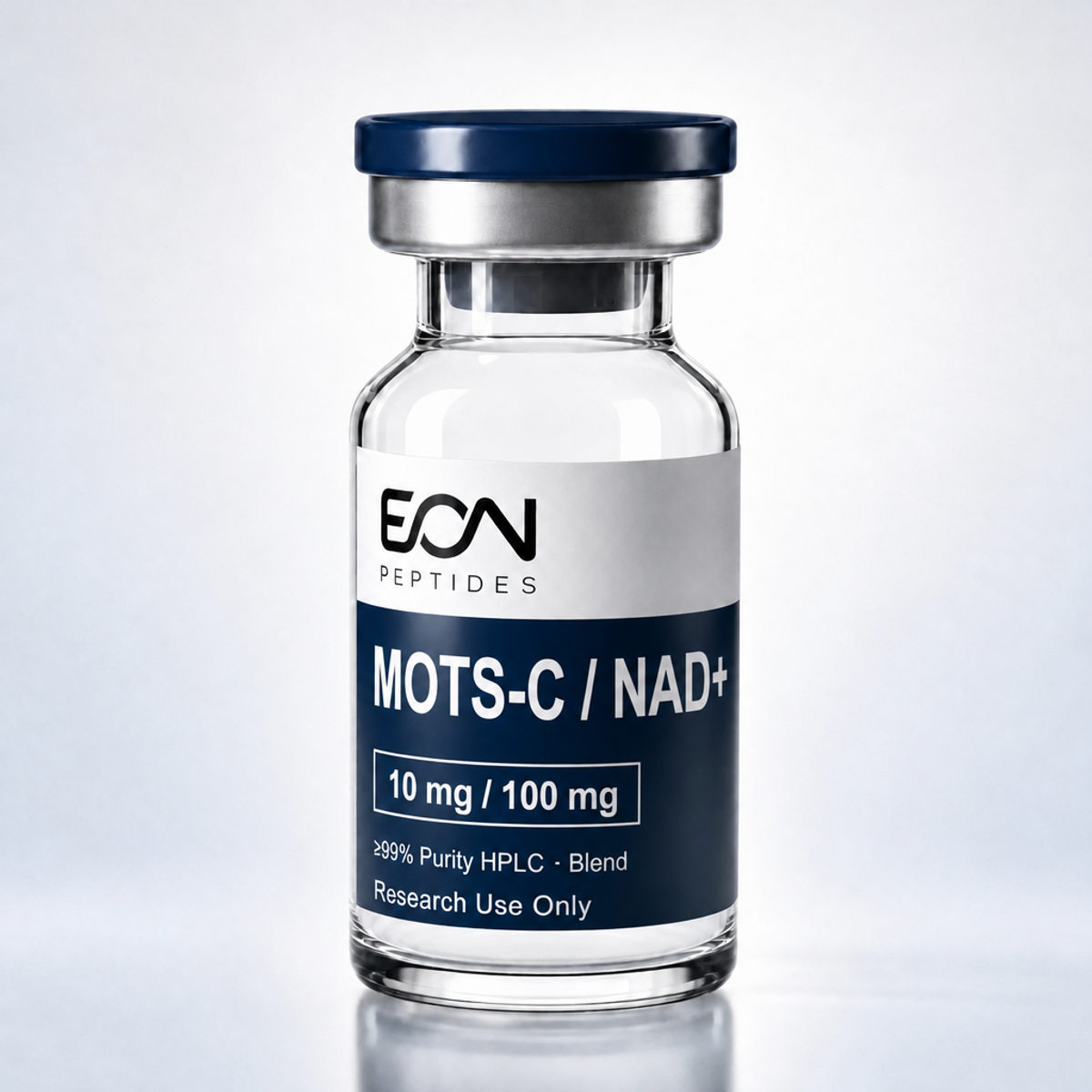
| Physical form | Lyophilized powder blend |
|---|---|
| Available sizes | 10mg / 100mg |
How it works
-
MOTS-c
AMPK Signalling
MOTS-c is a mitochondrial-derived peptide encoded in the mitochondrial genome. AMPK pathway activation and metabolic-regulation endpoints are the characterised readouts.
- Mitochondrial-derived peptide
- AMPK pathway activation
- Metabolic regulation endpoints
-
NAD+
Electron Carrier
NAD+ is a coenzyme present in every living cell. It carries electrons between reactions, and studies have measured its role in mitochondrial metabolism, cell signalling and DNA repair.
- Redox cofactor
- Mitochondrial metabolism
- DNA repair endpoints
-
Combined
Peptide and Cofactor
The vial pairs a signalling peptide with a metabolic cofactor. The two are characterised separately and no interaction data exists for the pair.
- Signalling and cofactor arms
- Matched handling
- Interaction not characterised
What the research shows
-
Cell Biology
Mitochondrial Function
Both compounds are studied in mitochondrial models from different angles.
-
Metabolic
Metabolic Regulation
MOTS-c is characterised for AMPK-pathway activation in metabolic models.
-
Biochemistry
Redox Studies
NAD+ is a standard cofactor in electron-transfer and redox assay work.
-
Methods
Parallel Protocols
One vial holds both compounds under matched handling.
Specification
| Components | MOTS-c + NAD+ |
|---|---|
| Content | 110 mg per vial (10 mg MOTS-c, 100 mg NAD+) |
| MOTS-c | 16-amino acid mitochondrial-derived peptide |
| NAD+ | Pyridine dinucleotide coenzyme, CAS 53-84-9 |
| Form | Lyophilized powder blend |
| Purity | ≥99% by HPLC |
| Appearance | White to off-white powder |
| Solubility | Water-soluble |
| Storage | -20°C, protected from light |
| Classification | Research use only |
Frequently asked questions
Why combine MOTS-c and NAD+?
They sit on the same subject from different sides: MOTS-c is a mitochondrial-derived signalling peptide, NAD+ is the coenzyme that carries electrons through mitochondrial metabolism. One vial holds both under matched handling.
Is NAD+ a peptide?
No. NAD+ is a pyridine dinucleotide coenzyme, not a peptide. It is included here as the cofactor arm of the blend and is characterised as a small molecule rather than by amino acid sequence.
Has the combination been characterised as a single formulation?
No. Each compound is characterised separately and no interaction data exists for the pair.
How does this differ from buying MOTS-c and NAD+ separately?
The separate products let you control each quantity independently and are offered in several sizes. This vial fixes the ratio at 10 mg and 100 mg.
What purity is documented?
Each lot is analysed by reverse-phase HPLC and released at ≥99%, with a Certificate of Analysis.
How is it stored?
Store lyophilized at -20°C for long-term stability, protected from light and moisture, and avoid repeated freeze-thaw cycles.
Related monographs
For laboratory research use only. Not a drug, supplement, or medical product; not for human or animal use. All findings referenced are from published preclinical/laboratory research.