
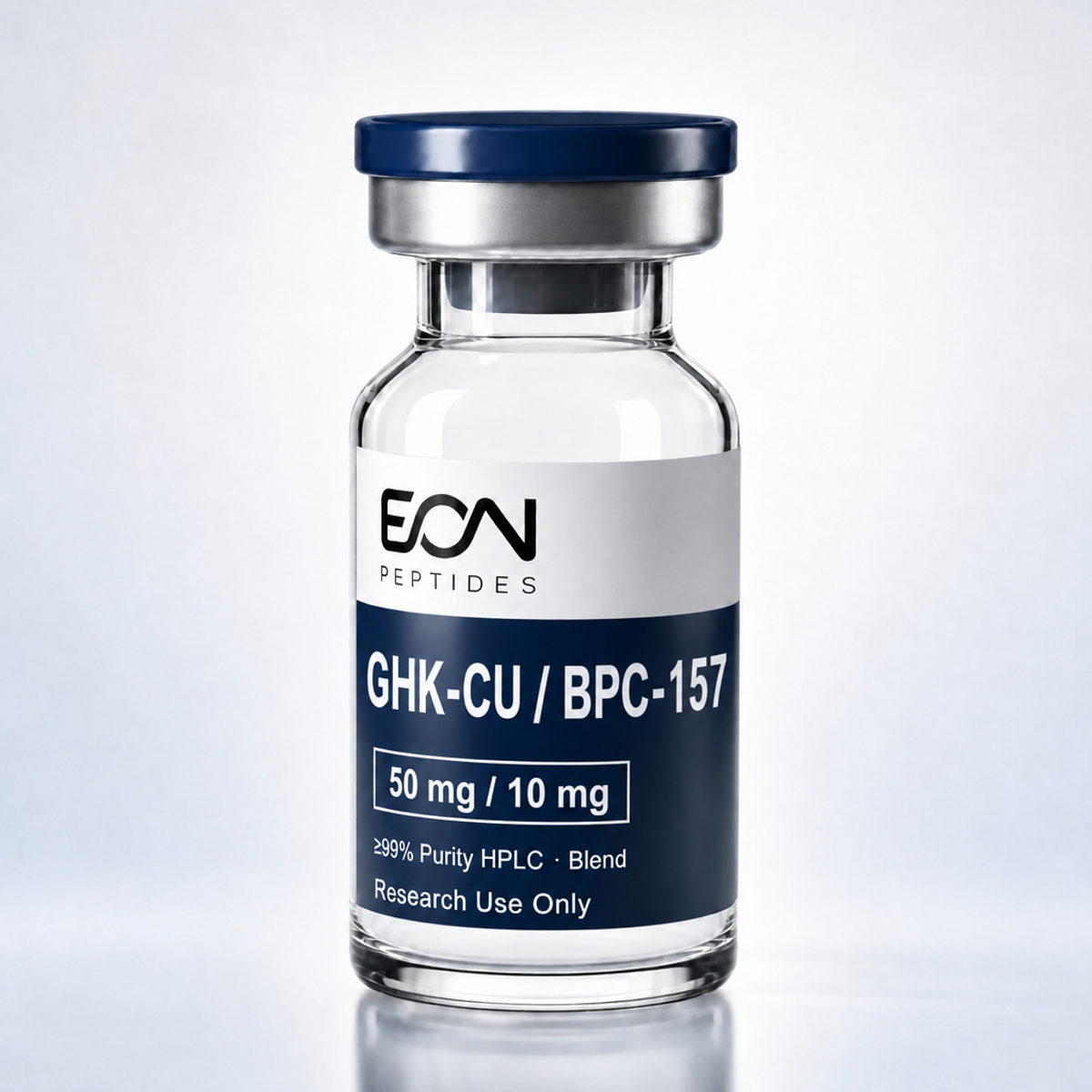
Molecular data
| Physical form | Lyophilized powder blend |
|---|---|
| Available sizes | 50mg / 10mg |
How it works
-
GHK-Cu
Copper Coordination
GHK-Cu is a tripeptide that binds copper(II). Collagen synthesis and extracellular-matrix endpoints are the characterised readouts in dermal research models.
- Copper(II) coordination
- Collagen synthesis endpoints
- Matrix remodelling readouts
-
BPC-157
Preclinical Remodelling
BPC-157 copies part of a protein found in gastric fluid. Preclinical models have measured new blood vessel growth, tendon cell migration and tissue remodelling after injury.
- Angiogenesis endpoints
- Tendon cell migration
- Stable in acidic conditions
-
Combined
Two Matrix Angles
The vial pairs a copper-coordinating tripeptide with a synthetic pentadecapeptide. The two are characterised separately and no interaction data exists for the pair.
- Copper and peptide arms
- Matched handling
- Interaction not characterised
What the research shows
-
Dermal
Matrix Research
GHK-Cu is among the more extensively characterised peptides in dermal research.
-
Cell Biology
Angiogenesis Models
BPC-157 has been measured for new blood vessel growth in preclinical models.
-
Cell Biology
Cell Migration
Tendon cell movement and spreading are documented BPC-157 endpoints.
-
Methods
Parallel Protocols
One vial holds both peptides under matched handling.
Specification
| Components | GHK-Cu + BPC-157 |
|---|---|
| Content | 60 mg per vial (50 mg GHK-Cu, 10 mg BPC-157) |
| GHK-Cu | Gly-His-Lys-Cu(II), CAS 49557-75-7 |
| BPC-157 | Synthetic pentadecapeptide, CAS 137525-51-0 |
| Form | Lyophilized powder blend |
| Purity | ≥99% by HPLC |
| Appearance | Blue to blue-grey powder (copper complex) |
| Solubility | Water-soluble |
| Storage | -20°C, protected from light |
| Classification | Research use only |
Frequently asked questions
Why combine GHK-Cu and BPC-157?
Both are studied in tissue and matrix models but by different mechanisms: GHK-Cu through copper coordination and collagen-synthesis endpoints, BPC-157 through angiogenesis and remodelling endpoints in preclinical models. One vial holds both under matched handling.
Why is the powder blue?
GHK-Cu is a copper(II) complex, and copper complexes of this type are blue to blue-grey. At 50 mg of the 60 mg total it dominates the appearance of the blend.
Has the combination been characterised as a single formulation?
No. Each peptide is characterised separately and no interaction data exists for the pair.
How does this differ from buying GHK-Cu and BPC-157 separately?
The separate products let you control each peptide quantity independently. This vial fixes the ratio at 50 mg and 10 mg.
What purity is documented?
Each lot is analysed by reverse-phase HPLC and released at ≥99%, with a Certificate of Analysis.
How is it stored?
Store lyophilized at -20°C for long-term stability, protected from light and moisture, and avoid repeated freeze-thaw cycles.
Related monographs
For laboratory research use only. Not a drug, supplement, or medical product; not for human or animal use. All findings referenced are from published preclinical/laboratory research.