
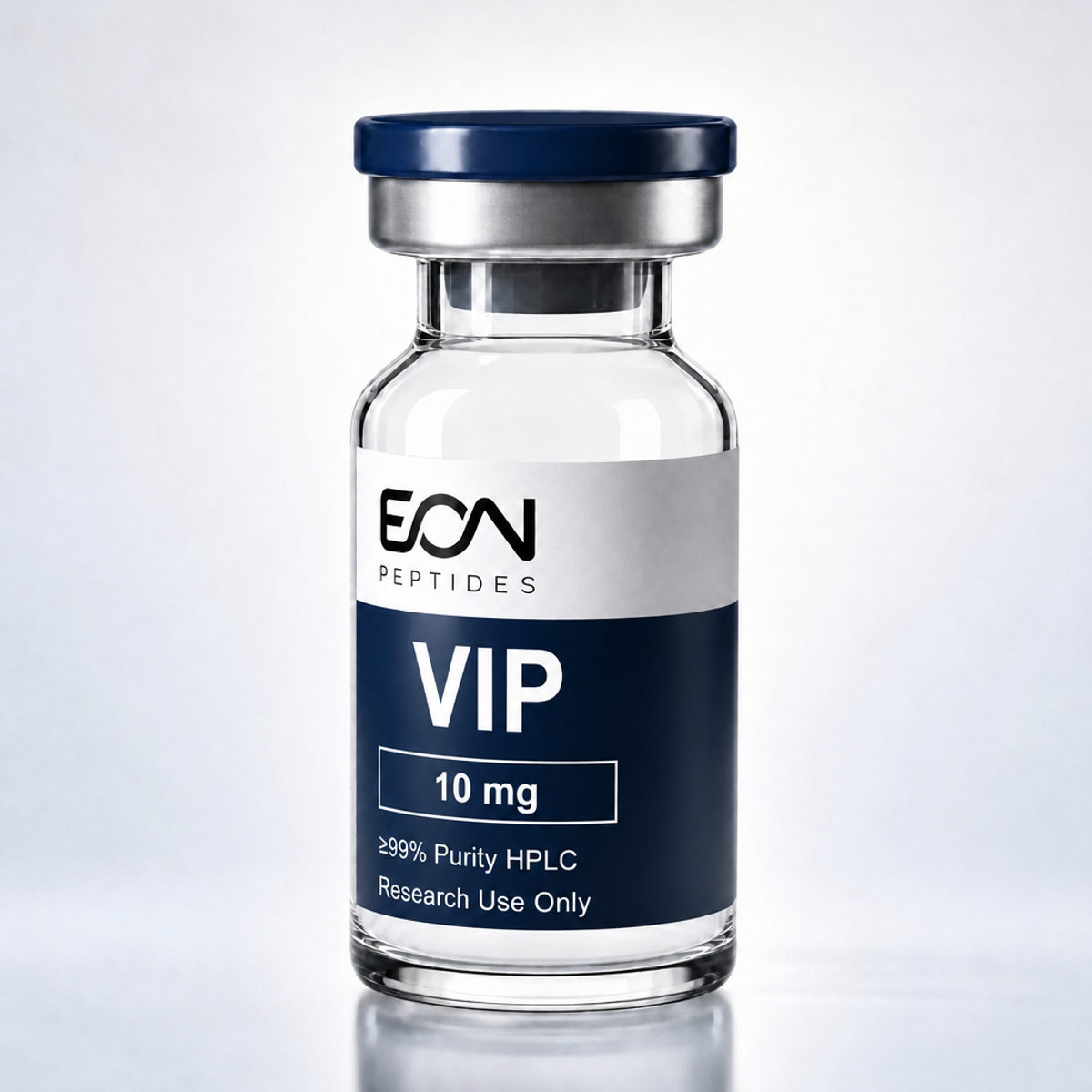
Molecular data
| Sequence length | 28 residues |
|---|---|
| Physical form | Lyophilized powder |
| Available sizes | 10mg |
How it works
-
Receptor
VPAC1 and VPAC2 Signalling
VIP binds the class B G-protein-coupled receptors VPAC1 and VPAC2. Adenylate cyclase activation and cyclic AMP accumulation are the principal characterised readouts.
- VPAC1 / VPAC2 engagement
- Adenylate cyclase activation
- Cyclic AMP accumulation
-
Physiology
Smooth Muscle Relaxation
Smooth-muscle relaxation endpoints are long characterised for VIP across vascular and gastrointestinal tissue preparations.
- Vascular preparations
- Gastrointestinal tissue
- Relaxation endpoints
-
Immunology
Immunomodulatory Endpoints
VIP is studied as an endogenous anti-inflammatory mediator, with cytokine-profile shifts measured in immune cell culture.
- Cytokine profile shifts
- Immune cell culture
- Anti-inflammatory mediator
What the research shows
-
Physiology
Smooth Muscle Models
Relaxation endpoints are characterised in vascular and gastrointestinal tissue preparations.
-
Immunology
Immunomodulation
Cytokine-profile endpoints are measured in immune cell culture.
-
Neuroscience
Neuroprotection Models
VIP appears in neuroprotection literature alongside its receptor-signalling characterisation.
-
Analytical
Reference Peptide
Used as a characterised VPAC-receptor agonist reference in assay development.
Specification
| Chemical Name | VIP (vasoactive intestinal peptide) |
|---|---|
| Length | 28 amino acids |
| Family | Secretin peptide family |
| Content | 10 mg per vial |
| Receptor Targets | VPAC1, VPAC2 (class B GPCRs) |
| Second Messenger | Cyclic AMP |
| Form | Lyophilized powder |
| Purity | ≥99% by HPLC |
| Solubility | Water-soluble |
| Storage | -20°C, protected from light |
| Classification | Research use only |
Frequently asked questions
What receptors does VIP act on?
VPAC1 and VPAC2, both class B G-protein-coupled receptors. Adenylate cyclase activation and cyclic AMP accumulation are the principal characterised readouts.
Is a molecular weight listed?
The molecular weight will be published here from the lot's Certificate of Analysis rather than quoted from a secondary source.
Is VIP related to PACAP?
Yes. Both belong to the secretin peptide family and share the VPAC receptors, which is why they are frequently studied together.
What purity is documented?
Each lot is analysed by reverse-phase HPLC and released at ≥99%, with a Certificate of Analysis.
How is it stored?
Store lyophilized at -20°C for long-term stability, protected from light and moisture, and avoid repeated freeze-thaw cycles.
Related monographs
For laboratory research use only. Not a drug, supplement, or medical product; not for human or animal use. All findings referenced are from published preclinical/laboratory research.