
The molecule, in three dimensions
- Heavy atoms
- 25
- Bonds
- 24
- Composition
- C14 Cu1 N6 O4
- Rings
- 1
- Metal centre
- Cu(II), three N donors
- Chain length
- 3 residues
Every heavy atom is placed from the sequence with ideal bond lengths and angles, so the connectivity is exact. The pose is idealised, a compact Cu(II) chelate, and is not a measured conformation. Identity for the lot in stock is confirmed by LC-MS on its certificate.
Molecular data
| Molecular formula | C₁₄H₂₄CuN₆O₄ |
|---|---|
| Molecular weight | 403.9 Da |
| Sequence | Gly-His-Lys-Cu(II) |
| Sequence length | 3 residues |
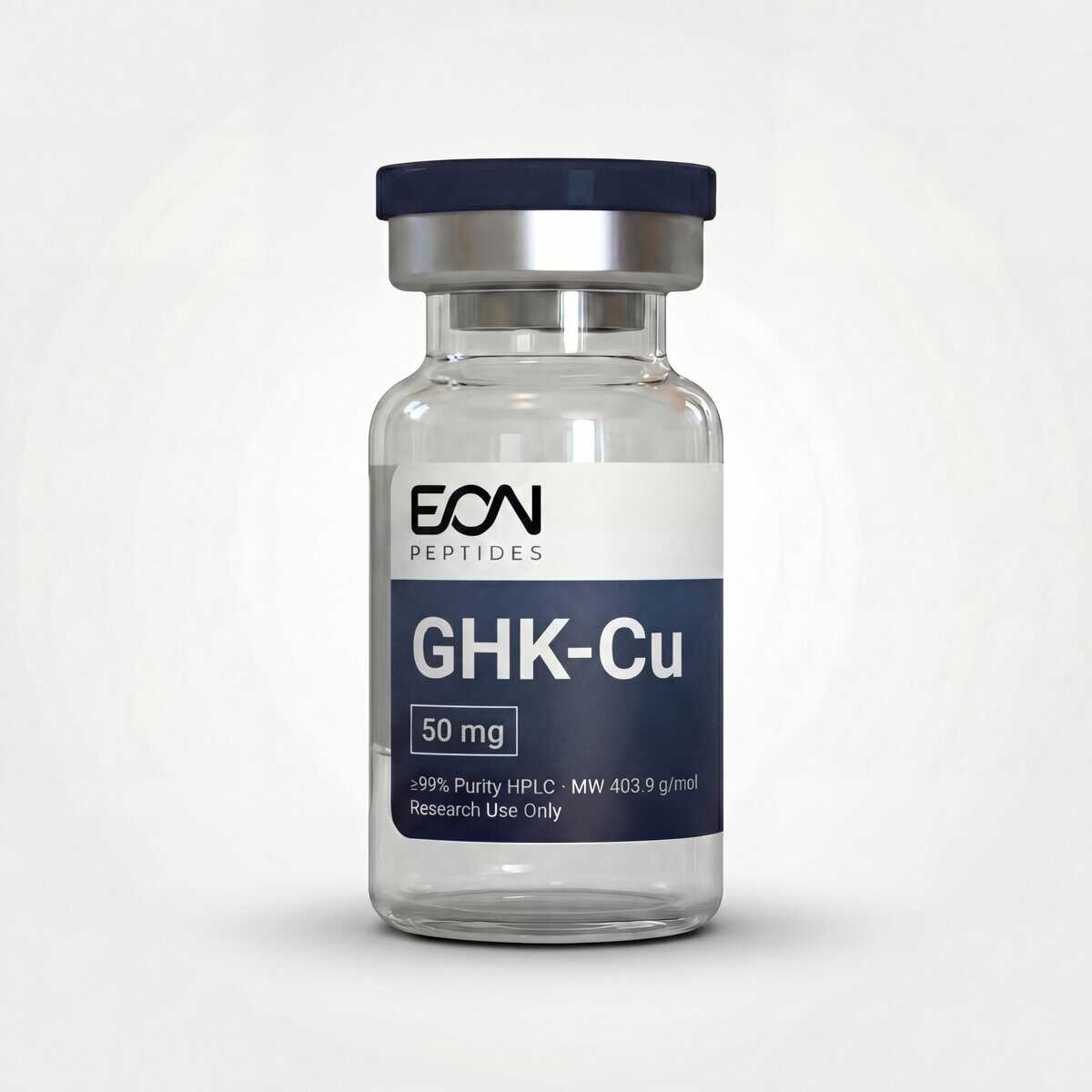
| CAS / identifier | 49557-75-7 |
| Physical form | Lyophilized powder |
| Available sizes | 50mg, 100mg |
How it works
-
Copper Delivery
Copper Transport & Signaling
GHK-Cu chelates copper(II) ions and delivers them to cells. Copper-dependent enzymes involved in collagen crosslinking, antioxidant activity and tissue remodelling have been measured following exposure.
- High-affinity copper(II) binding
- Lysyl oxidase activity measured in collagen crosslinking
- Superoxide dismutase activity measured
-
Collagen Synthesis
ECM Remodelling
Fibroblast production of type I and III collagen, glycosaminoglycans and decorin has been measured in culture, alongside changes in extracellular matrix architecture.
- 70% higher collagen synthesis vs controls in fibroblast culture
- Glycosaminoglycan production measured
- Decorin synthesis for matrix organization
-
Gene Modulation
Genomic Reprogramming
Gene expression work reports changes across 4,000+ human genes following GHK-Cu exposure - among the broadest transcriptional footprints recorded for a short peptide.
- 4,000+ genes with altered expression
- Raised DNA repair gene expression reported
- Suppresses inflammatory gene expression
What the research shows
-
Dermatology
Dermal Models
Collagen, elastin and glycosaminoglycan synthesis measured in fibroblast culture. Studied extensively in wound-closure and dermal-ageing models.
-
Trichology
Hair Follicle Models
Associated with larger follicle size, follicle growth and hair-cycle transition in preclinical models.
-
Genomics
Gene Expression
Expression changes reported across 4,000+ genes, including DNA repair, antioxidant and inflammatory pathways.
-
Antioxidant
Antioxidant Enzyme Activity
Chelates free copper, with lower oxidative-damage markers and raised superoxide dismutase activity measured in the same systems.
Specification
| Sequence | Gly-His-Lys-Cu(II) |
|---|---|
| Molecular Weight | 403.9 Da |
| Molecular Formula | C₁₄H₂₄CuN₆O₄ |
| Form | Lyophilized powder |
| Purity | ≥99% (HPLC verified) |
| Testing | Third-party HPLC, Mass Spec, Endotoxin |
| Storage | -20°C for up to 24 months |
| Solubility | Water-soluble |
| COA | Included with every order |
How it's tested
Every lot of GHK-Cu released to the catalog carries a third-party certificate of analysis. 12 documented lots are on file for this compound, with reported HPLC purity from 99.54% to 99.95% (mean 99.79%), issued by Accurate Test Labs and Freedom Diagnostics. 10 of 12 certificates record identity as confirmed.
- Documented lots
- 12
- Reported purity
- 99.54% to 99.95%
- Mean purity
- 99.79%
- Issuing labs
- Accurate Test Labs, Freedom Diagnostics
- 2026-09-03 Lot CU-090226-100Accurate Test Labs 99.93% View certificate
- 2026-09-03 Lot CU-090226-50Accurate Test Labs 99.92% View certificate
- 2026-08-18 Lot A6S43WAccurate Test Labs 99.88% View certificate
Frequently asked questions
What is GHK-Cu and where does it come from?
GHK-Cu (glycyl-L-histidyl-L-lysine copper) is a naturally occurring copper-binding tripeptide first isolated from human plasma in 1973 by Dr. Loren Pickart. It is found in human blood, saliva, and urine, with plasma levels declining from approximately 200 ng/mL at age 20 to 80 ng/mL by age 60.
What has research shown about GHK-Cu?
Preclinical research has studied GHK-Cu in wound-closure and dermal models, including collagen and glycosaminoglycan synthesis; recruitment of immune and endothelial cells to injury sites; anti-inflammatory and antioxidant activity; and expression changes across over 4,000 genes.
Is GHK-Cu FDA approved?
GHK-Cu is not FDA approved as a drug. It is available as a research peptide and is also found in some cosmetic formulations. The lyophilized material sold here is for in vitro research purposes only.
How is GHK-Cu used in research settings?
GHK-Cu has been studied in cultured cell systems and in animal models, with copper binding, collagen-related gene expression and tissue-remodelling endpoints. Concentrations and endpoints differ between experiments.
What is the molecular structure of GHK-Cu?
GHK-Cu consists of three amino acids - glycine, histidine, and lysine - complexed with a copper(II) ion. The molecular formula is C₁₄H₂₄CuN₆O₄ with a molecular weight of approximately 403.9 Da. The histidine residue provides the primary copper-binding site.
How should GHK-Cu be stored?
Lyophilized GHK-Cu should be stored at -20°C for maximum stability (up to 24 months). Avoid repeated freeze-thaw cycles and protect from light.
Related monographs
For laboratory research use only. Not a drug, supplement, or medical product; not for human or animal use. All findings referenced are from published preclinical/laboratory research.