
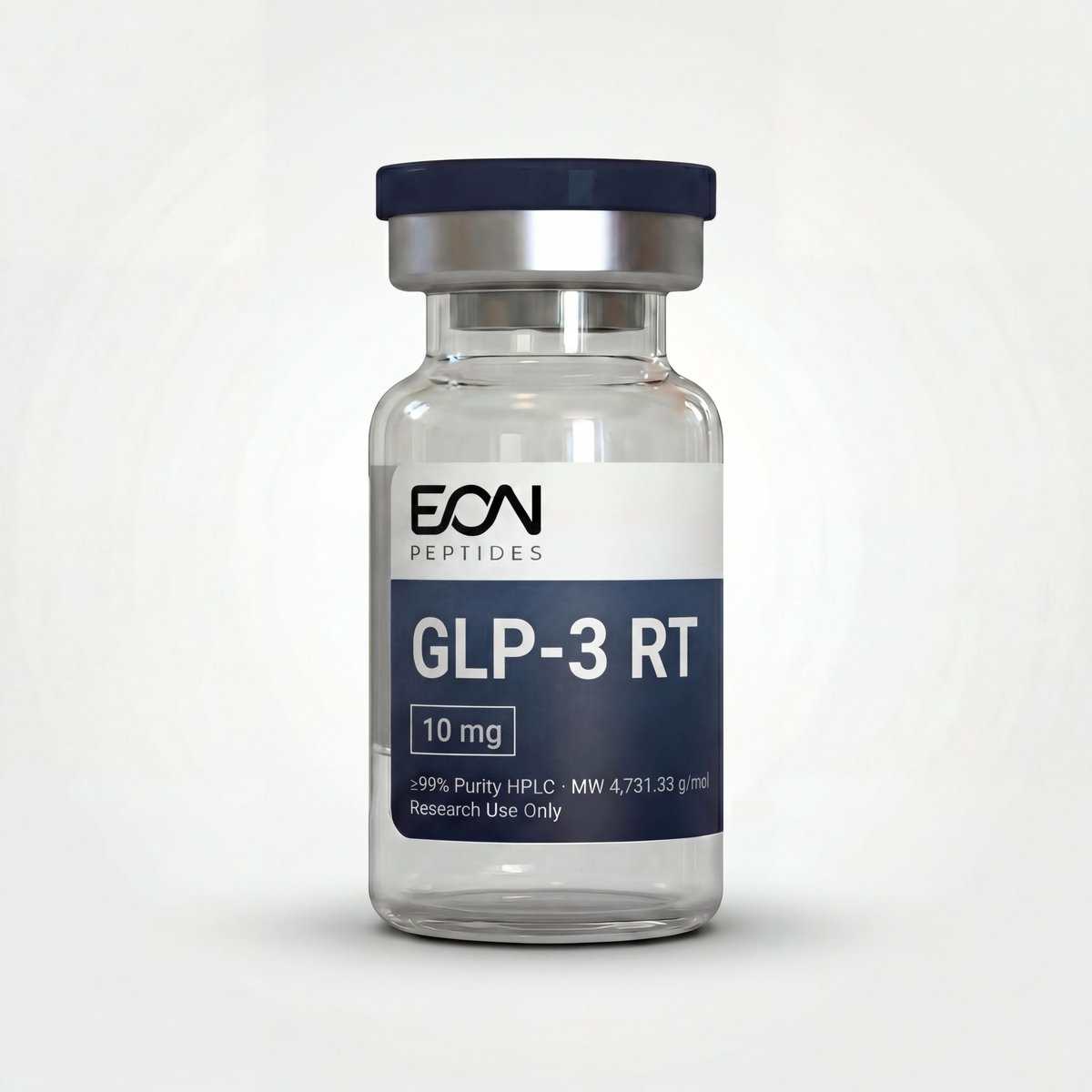
Molecular data
| Molecular formula | C221H342N50O68 |
|---|---|
| Molecular weight | 4731.32 Da |
| Sequence | GLP-3 RT - synthetic triagonist peptide; full sequence not disclosed on page |
| Sequence length | 39 residues |
| CAS / identifier | CAS 2381089-83-2 |
| Physical form | Lyophilized powder |
| Available sizes | 10mg, 15mg, 24mg, 30mg, 48mg, 60mg |
How it works
-
GLP-1R
GLP-1 Receptor Agonism
Binds GLP-1 receptors. Published characterisation describes glucose-dependent insulin secretion, glucagon suppression, delayed gastric emptying and hypothalamic appetite-pathway signalling. This is the same pathway targeted by GLP-1 S and liraglutide.
- Glucose-dependent insulin secretion
- Delayed gastric emptying
- Central appetite-pathway signalling
-
GIPR
GIP Receptor Agonism
Co-agonism at GIP receptors is studied for interaction with GLP-1 signaling, lipid metabolism and adipose tissue remodeling. This dual GLP-1/GIP mechanism is shared with GLP-2 TZ, but GLP-3 RT adds a third target.
- Insulin secretion under GIP co-agonism
- Lipid metabolism endpoints
- Adipose tissue signaling
-
GCGR
Glucagon Receptor Agonism
The unique third target - glucagon receptor activation, studied in relation to hepatic energy expenditure, fatty acid oxidation and thermogenesis. This differentiates GLP-3 RT from all dual agonists in receptor coverage.
- Hepatic energy expenditure measured
- Fatty acid oxidation measured
- Thermogenic pathway activation
What the research shows
-
Metabolic
Metabolic Receptor Research
Triple receptor engagement at GLP-1, GIP and glucagon receptors is the focus of metabolic research on this compound.
-
Endocrine
Glycemic Pathway Research
Glycemic endpoints including HbA1c and fasting glucose are among the measures examined in metabolic research on this compound.
-
Hepatic
Hepatic Lipid Models (MASLD/MASH)
Hepatic lipid content is an endpoint reported for this compound in preclinical and early clinical literature, within metabolic dysfunction-associated steatotic liver disease research.
-
Comparative
Triple vs Dual Agonism
GLP-3 RT is characterised alongside other glucagon receptor agonists including survodutide, mazdutide and cotadutide, which differ in receptor coverage.
Specification
| Compound Class | Triple GLP-1/GIP/Glucagon receptor agonist |
|---|---|
| Research Name | GLP-3 RT |
| Targets | GLP-1R + GIPR + GCGR |
| Form | Lyophilized powder |
| Purity | ≥99% (HPLC verified) |
| Testing | Third-party HPLC, Mass Spec, Endotoxin |
| Storage | -20°C for long-term stability |
| Solubility | Water-soluble |
| COA | Included with every order |
| Stability | 24 months from manufacture date when stored properly |
| Appearance | White to off-white powder |
| Molecular Formula | Available on request |
How it's tested
Every lot of GLP-3 RT released to the catalog carries a third-party certificate of analysis. 16 documented lots are on file for this compound, with reported HPLC purity from 99.00% to 99.96% (mean 99.70%), issued by Accurate Test Labs, Freedom Diagnostics and pH Solutions. 13 of 16 certificates record identity as confirmed.
- Documented lots
- 16
- Reported purity
- 99.00% to 99.96%
- Mean purity
- 99.70%
- Issuing labs
- Accurate Test Labs, Freedom Diagnostics, pH Solutions
- 2026-09-03 Lot GLP3-RT-090226-60Accurate Test Labs 99.84% View certificate
- 2026-09-03 Lot GLP3-RT-090226-10Accurate Test Labs 99.64% View certificate
- 2026-08-31 Lot J5QQA2Accurate Test Labs 99.96% View certificate
Frequently asked questions
What is GLP-3 RT?
GLP-3 RT is a triple hormone receptor agonist. It binds three receptors: GLP-1 (appetite and insulin signalling), GIP (metabolic signalling) and glucagon (energy metabolism). That receptor coverage distinguishes it from single-agonists like GLP-1 S and dual-agonists like GLP-2 TZ.
How does GLP-3 RT differ from GLP-1 S and GLP-2 TZ?
GLP-1 S targets GLP-1 only. GLP-2 TZ targets GLP-1 + GIP (dual agonist). GLP-3 RT targets GLP-1 + GIP + Glucagon (triple agonist). The distinction is receptor coverage.
What is the current development status of GLP-3 RT?
GLP-3 RT remains an investigational compound. It is not approved by the FDA or any regulatory agency for human use, and it is supplied on eonpeptides.com exclusively for in vitro laboratory research. No clinical endpoint is offered as a property of this material.
Is GLP-3 RT FDA approved?
No. GLP-3 RT is currently in Phase 3 clinical trials (the TRIUMPH program). GLP-3 RT is a research compound sold exclusively for in vitro laboratory research. It is not FDA approved and should not be confused with approved medications.
How should GLP-3 RT be stored?
Store lyophilized at -20°C for long-term stability. Protect from direct light and avoid repeated freeze-thaw cycles.
Related monographs
For laboratory research use only. Not a drug, supplement, or medical product; not for human or animal use. All findings referenced are from published preclinical/laboratory research.