
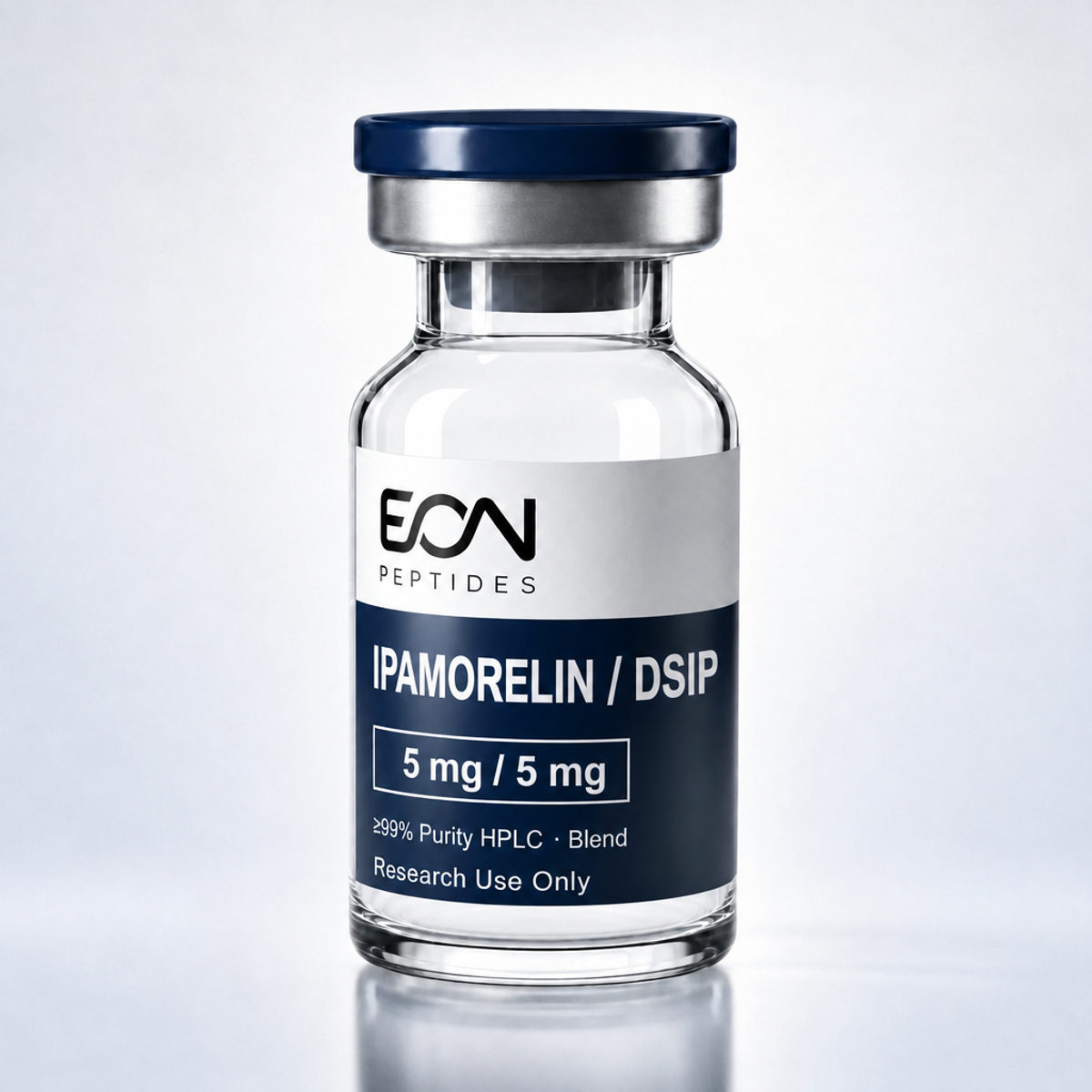
Molecular data
| Physical form | Lyophilized powder blend |
|---|---|
| Available sizes | 5mg / 5mg |
How it works
-
Ipamorelin
GHS-R Binding
Ipamorelin binds GHS-R, the growth hormone secretagogue receptor. Selectivity is the main point of study: compared with older compounds in the same class it shows little effect on cortisol, prolactin and ACTH.
- GHS-R1a agonist
- Growth hormone release endpoints
- Selectivity vs older secretagogues
-
DSIP
Unresolved Receptor
DSIP was first isolated in 1977 from blood drawn during deep sleep. Brain wave patterns, sleep timing and stress hormone response have been measured, but after nearly fifty years no receptor has been identified.
- Nine amino acid neuropeptide
- Sleep timing endpoints
- Mechanism still unresolved
-
Combined
Two Literatures
The vial pairs a receptor-defined secretagogue with a neuropeptide whose receptor is unknown. The two are characterised separately and no interaction data exists for the pair.
- Endocrine and neuro arms
- Matched handling
- Interaction not characterised
What the research shows
-
Endocrine
GH Pulse Studies
Ipamorelin is characterised for growth hormone release and class selectivity.
-
Neuro
Sleep Architecture
DSIP has been measured for brain wave patterns and sleep timing.
-
Endocrine
Stress Response
Both peptides appear in stress hormone literature from different directions.
-
Methods
Parallel Protocols
One vial holds both peptides under matched handling.
Specification
| Components | Ipamorelin + DSIP |
|---|---|
| Content | 10 mg per vial (5 mg of each component) |
| Ipamorelin | Aib-His-D-2-Nal-D-Phe-Lys-NH₂, CAS 170851-70-4 |
| DSIP | Trp-Ala-Gly-Gly-Asp-Ala-Ser-Gly-Glu, CAS 62568-57-4 |
| Form | Lyophilized powder blend |
| Purity | ≥99% by HPLC |
| Appearance | White to off-white powder |
| Solubility | Water-soluble |
| Storage | -20°C, protected from light |
| Classification | Research use only |
Frequently asked questions
Why combine Ipamorelin and DSIP?
They come from two different literatures that overlap in circadian and endocrine research: Ipamorelin through GHS-R binding and growth hormone release, DSIP through sleep timing and stress hormone endpoints. One vial holds both under matched handling.
Is DSIP mechanism established?
No. DSIP has been studied since 1977 and its endpoints are documented, but no receptor has been identified and the mechanism remains unresolved.
Has the combination been characterised as a single formulation?
No. Each peptide is characterised separately and no interaction data exists for the pair.
How does this differ from buying Ipamorelin and DSIP separately?
The separate products let you control each peptide quantity independently. This vial fixes the ratio at 5 mg and 5 mg.
What purity is documented?
Each lot is analysed by reverse-phase HPLC and released at ≥99%, with a Certificate of Analysis.
How is it stored?
Store lyophilized at -20°C for long-term stability, protected from light and moisture, and avoid repeated freeze-thaw cycles.
Related monographs
For laboratory research use only. Not a drug, supplement, or medical product; not for human or animal use. All findings referenced are from published preclinical/laboratory research.