
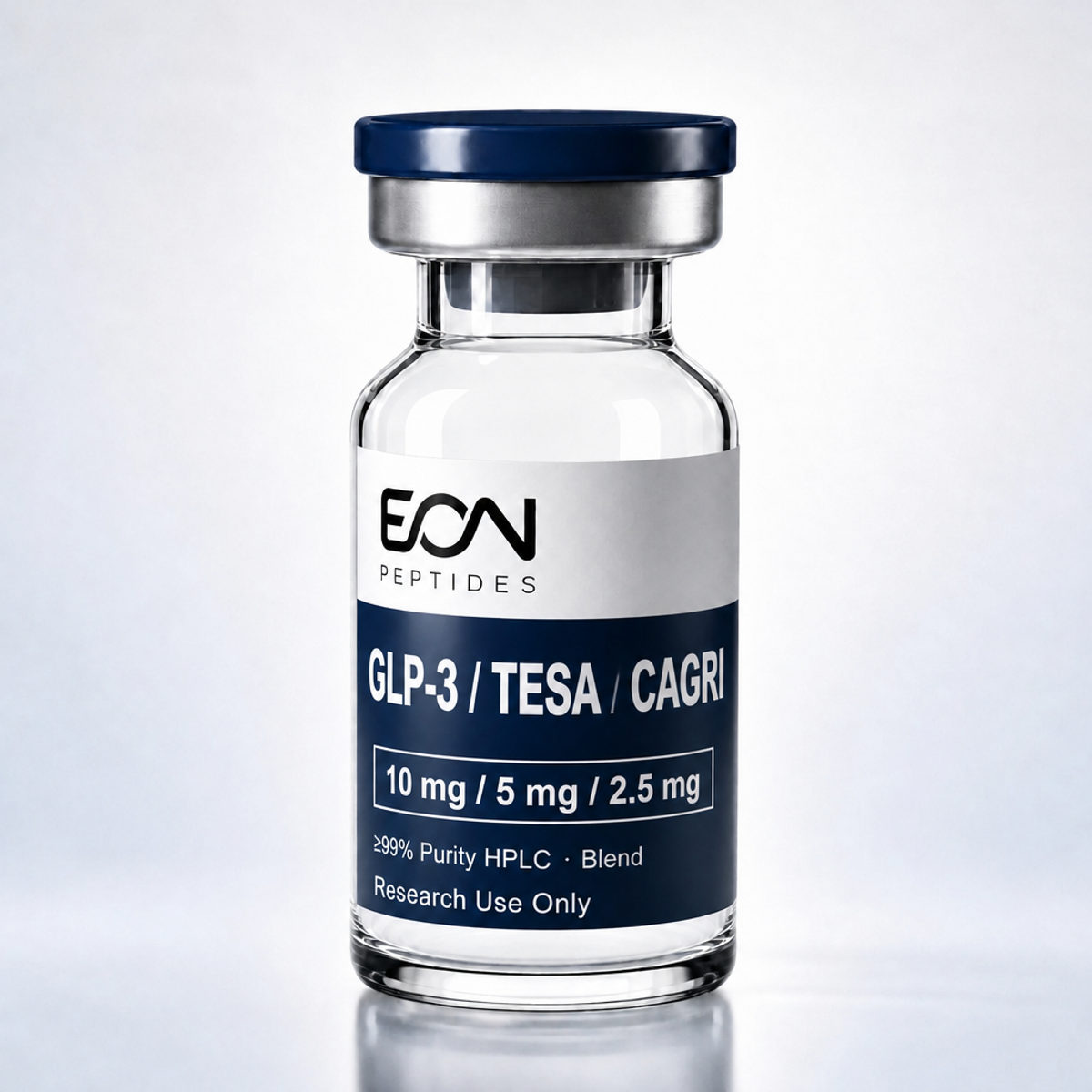
Molecular data
| Physical form | Lyophilized powder blend |
|---|---|
| Available sizes | 10mg / 5mg / 2.5mg |
How it works
-
GLP-3
Triple Receptor Activity
Agonism at the GIP, GLP-1 and glucagon receptors is characterised, with energy-expenditure and hepatic-lipid endpoints measured alongside the incretin readouts.
- GIP · GLP-1 · glucagon
- Energy expenditure
- Hepatic lipid measures
-
Tesa
GHRH-Axis Signalling
Tesamorelin is a GHRH analog studied for pulsatile growth-hormone release and downstream IGF-1 measures in GH-axis research.
- GHRH receptor engagement
- Pulsatile GH release
- IGF-1 endpoints
-
Cagri
Amylin Receptor Signalling
Satiety signalling and gastric-emptying rate are the characterised endpoints for amylin analogs.
- Amylin receptor complexes
- Satiety signalling
- Gastric-emptying rate
What the research shows
-
Metabolic
Energy Balance Models
Energy-expenditure endpoints are characterised for the glucagon-receptor arm.
-
Endocrinology
GH-Axis Research
Tesamorelin is studied for GHRH-receptor engagement and downstream IGF-1 measures.
-
Metabolic
Satiety Signalling
The amylin arm carries satiety and gastric-emptying endpoints.
-
Methods
Three-Arm Protocols
One vial holds three distinct pathway arms under matched handling.
Specification
| Components | GLP-3 + Tesamorelin + Cagri |
|---|---|
| Content | 17.5 mg per vial (10 mg + 5 mg + 2.5 mg) |
| Pathways | Incretin · GHRH axis · amylin |
| Form | Lyophilized powder blend |
| Purity | ≥99% by HPLC |
| Appearance | White to off-white powder |
| Solubility | Water-soluble |
| Storage | -20°C, protected from light |
| Classification | Research use only |
Frequently asked questions
Why these three compounds together?
They cover three separate pathways: multi-receptor incretin signalling, the GHRH axis, and amylin signalling. The vial holds all three under matched handling.
Has the combination been characterised as a single formulation?
No. Each compound is characterised separately and no interaction data exists for the three together.
Why is Cagri the smallest fraction?
The ratio follows the supplier's formulation at 10 mg, 5 mg and 2.5 mg. It is fixed and cannot be varied within the vial.
What purity is documented?
Each lot is analysed by reverse-phase HPLC and released at ≥99%, with a Certificate of Analysis.
How is it stored?
Store lyophilized at -20°C for long-term stability, protected from light and moisture, and avoid repeated freeze-thaw cycles.
Related monographs
For laboratory research use only. Not a drug, supplement, or medical product; not for human or animal use. All findings referenced are from published preclinical/laboratory research.