
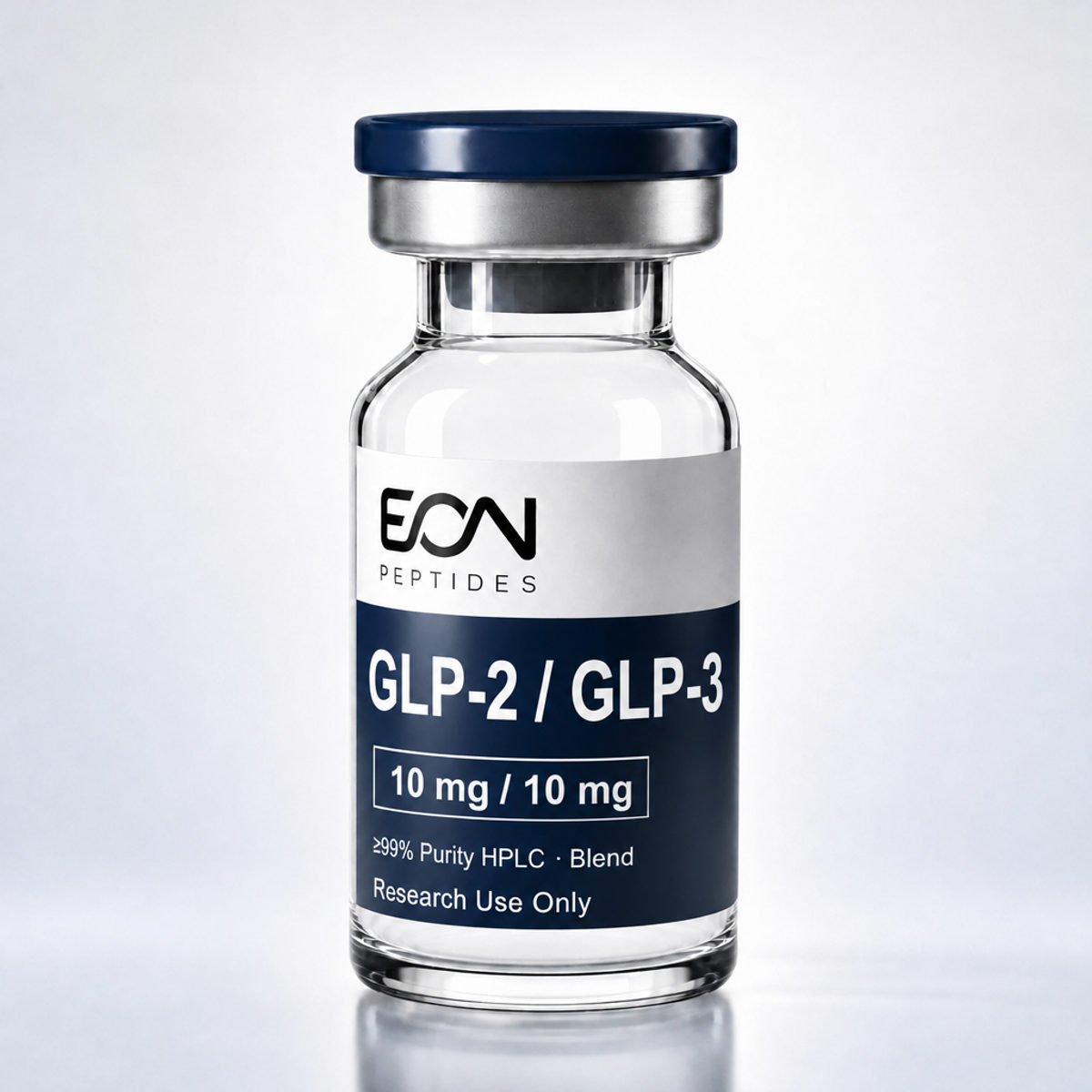
Molecular data
| Physical form | Lyophilized powder blend |
|---|---|
| Available sizes | 10mg / 10mg |
How it works
-
GLP-2
Dual Incretin Receptor Activity
GLP-2 is characterised as a co-agonist at the GIP and GLP-1 receptors. Insulinotropic signalling and gastric-emptying endpoints are the measured readouts in preclinical models.
- GIP receptor engagement
- GLP-1 receptor engagement
- Glucose-dependent insulin release
-
GLP-3
Triple Receptor Activity
GLP-3 adds glucagon-receptor agonism to the GIP/GLP-1 pair. Energy-expenditure and hepatic-lipid endpoints are characterised alongside the incretin readouts.
- Glucagon receptor engagement
- Energy expenditure endpoints
- Hepatic lipid measures
-
Combined
Comparative Conditions
Holding both compounds in one vial lets a protocol compare dual- and triple-receptor coverage under matched handling. No interaction between the two has been characterised.
- Matched storage and handling
- Comparative receptor coverage
- Interaction not characterised
What the research shows
-
Metabolic
Glucose Handling Models
Both compounds are studied for glucose-dependent insulin release in preclinical metabolic models.
-
Metabolic
Energy Balance
Energy-expenditure endpoints are characterised for the glucagon-receptor arm contributed by GLP-3.
-
Hepatology
Hepatic Lipid Measures
Hepatic lipid content is a recurring endpoint in triple-agonist literature.
-
Methods
Comparative Protocols
A single vial holding both compounds supports side-by-side receptor-coverage work under matched conditions.
Specification
| Components | GLP-2 + GLP-3 |
|---|---|
| Content | 20 mg per vial (10 mg of each component) |
| Receptor Targets | GIP · GLP-1 · glucagon |
| Form | Lyophilized powder blend |
| Purity | ≥99% by HPLC |
| Appearance | White to off-white powder |
| Solubility | Water-soluble |
| Storage | -20°C, protected from light |
| Classification | Research use only |
Frequently asked questions
Why combine GLP-2 and GLP-3?
The two cover different receptor sets. GLP-2 is characterised at the GIP and GLP-1 receptors; GLP-3 adds glucagon-receptor activity. Holding both in one vial supports comparative work under matched handling.
Has the combination been characterised as a single formulation?
No. Each compound is characterised separately in the literature. The blend is a formulation convenience and no interaction data exists for the pair.
How does this differ from buying GLP-2 TZ and GLP-3 RT separately?
The separate products let you control each compound's quantity independently. This vial fixes the ratio at 10 mg and 10 mg.
What purity is documented?
Each lot is analysed by reverse-phase HPLC and released at ≥99%. A Certificate of Analysis accompanies the lot.
How is it stored?
Store lyophilized at -20°C for long-term stability, protected from light and moisture, and avoid repeated freeze-thaw cycles.
Related monographs
For laboratory research use only. Not a drug, supplement, or medical product; not for human or animal use. All findings referenced are from published preclinical/laboratory research.