
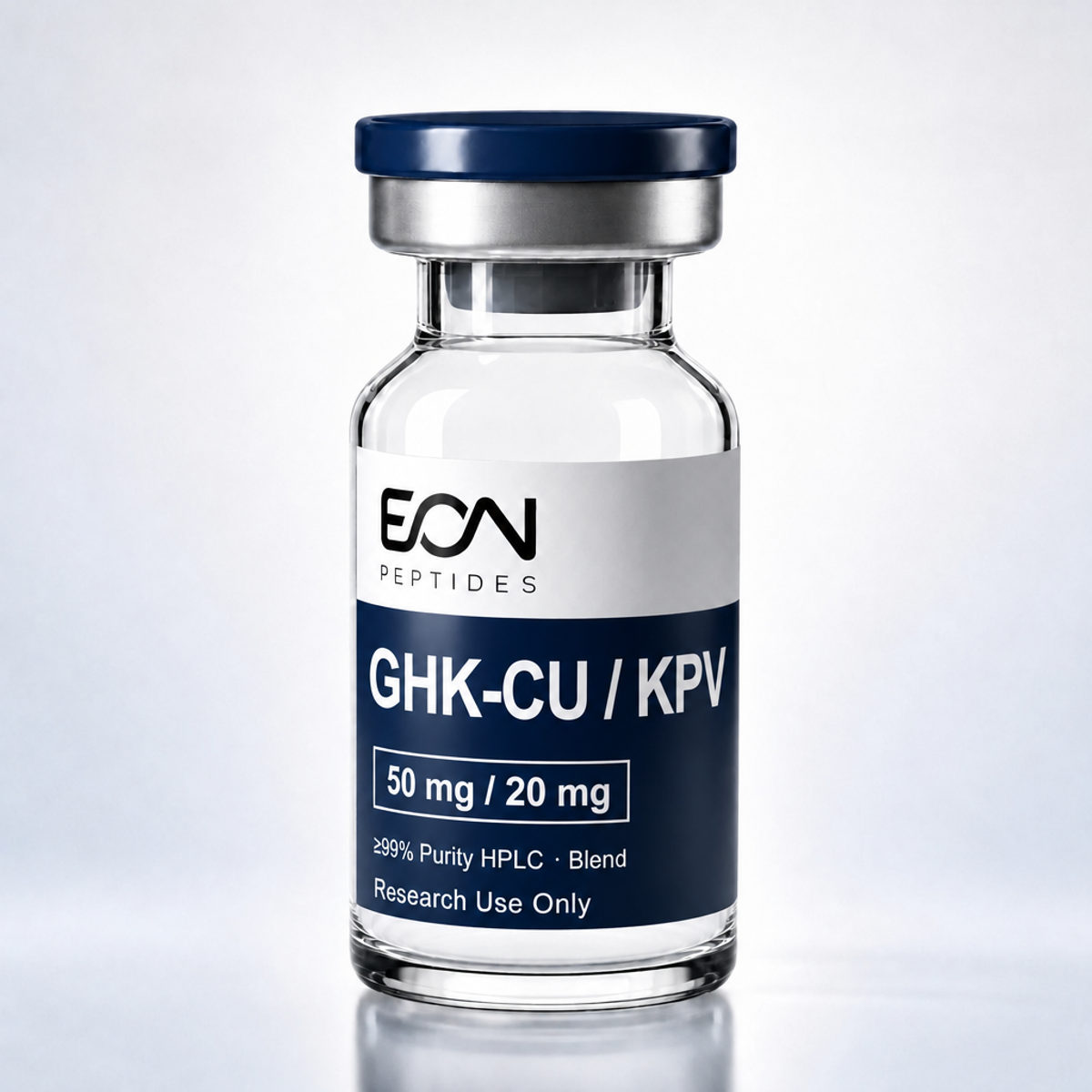
Molecular data
| Physical form | Lyophilized powder blend |
|---|---|
| Available sizes | 50mg / 20mg |
How it works
-
GHK-Cu
Copper Transport & Matrix Remodelling
GHK-Cu is a copper-binding tripeptide. Collagen and glycosaminoglycan synthesis endpoints are characterised in dermal fibroblast culture, alongside copper-transport activity.
- Copper-binding tripeptide
- Collagen synthesis endpoints
- Dermal fibroblast models
-
KPV
Inflammatory Pathway Suppression
KPV is the C-terminal tripeptide of α-MSH. Lower NF-κB and MAP-kinase pathway activation is measured in vitro at nanomolar concentrations, alongside reduced TNF-α and IL-6 secretion.
- α-MSH C-terminal fragment
- NF-κB pathway suppression
- Cytokine secretion endpoints
-
Combined
Matrix and Inflammatory Arms
The vial pairs a matrix-remodelling arm with an inflammatory-signalling arm. Both are characterised separately; no interaction data exists for the pair.
- Two complementary arms
- Matched handling
- Interaction not characterised
What the research shows
-
Dermatology
Skin Remodelling Models
GHK-Cu is characterised for collagen and glycosaminoglycan synthesis in dermal fibroblast culture.
-
Immunology
Inflammatory Signalling
KPV is studied for NF-κB pathway suppression and cytokine secretion endpoints.
-
Dermatology
Wound Closure Models
Both peptides appear in wound-model literature from different mechanistic angles.
-
Methods
Parallel Protocols
One vial holds both peptides under matched handling.
Specification
| Components | GHK-Cu + KPV |
|---|---|
| Content | 70 mg per vial (50 mg GHK-Cu + 20 mg KPV) |
| GHK-Cu Sequence | Gly-His-Lys (copper complex) |
| KPV Sequence | Lys-Pro-Val (α-MSH 11-13) |
| KPV Molecular Weight | 342.43 g/mol |
| Form | Lyophilized powder blend |
| Purity | ≥99% by HPLC |
| Solubility | Water-soluble |
| Storage | -20°C, protected from light |
| Classification | Research use only |
Frequently asked questions
Why combine GHK-Cu and KPV?
They cover different arms of skin and inflammation research: GHK-Cu for matrix remodelling, KPV for inflammatory signalling. One vial holds both under matched handling.
Why is the ratio uneven?
The formulation is 50 mg GHK-Cu to 20 mg KPV, following the supplier's specification. It is fixed and cannot be varied within the vial.
Has the combination been characterised as a single formulation?
No. Each peptide is characterised separately and no interaction data exists for the pair.
What purity is documented?
Each lot is analysed by reverse-phase HPLC and released at ≥99%, with a Certificate of Analysis.
How is it stored?
Store lyophilized at -20°C for long-term stability, protected from light and moisture, and avoid repeated freeze-thaw cycles.
Related monographs
For laboratory research use only. Not a drug, supplement, or medical product; not for human or animal use. All findings referenced are from published preclinical/laboratory research.