
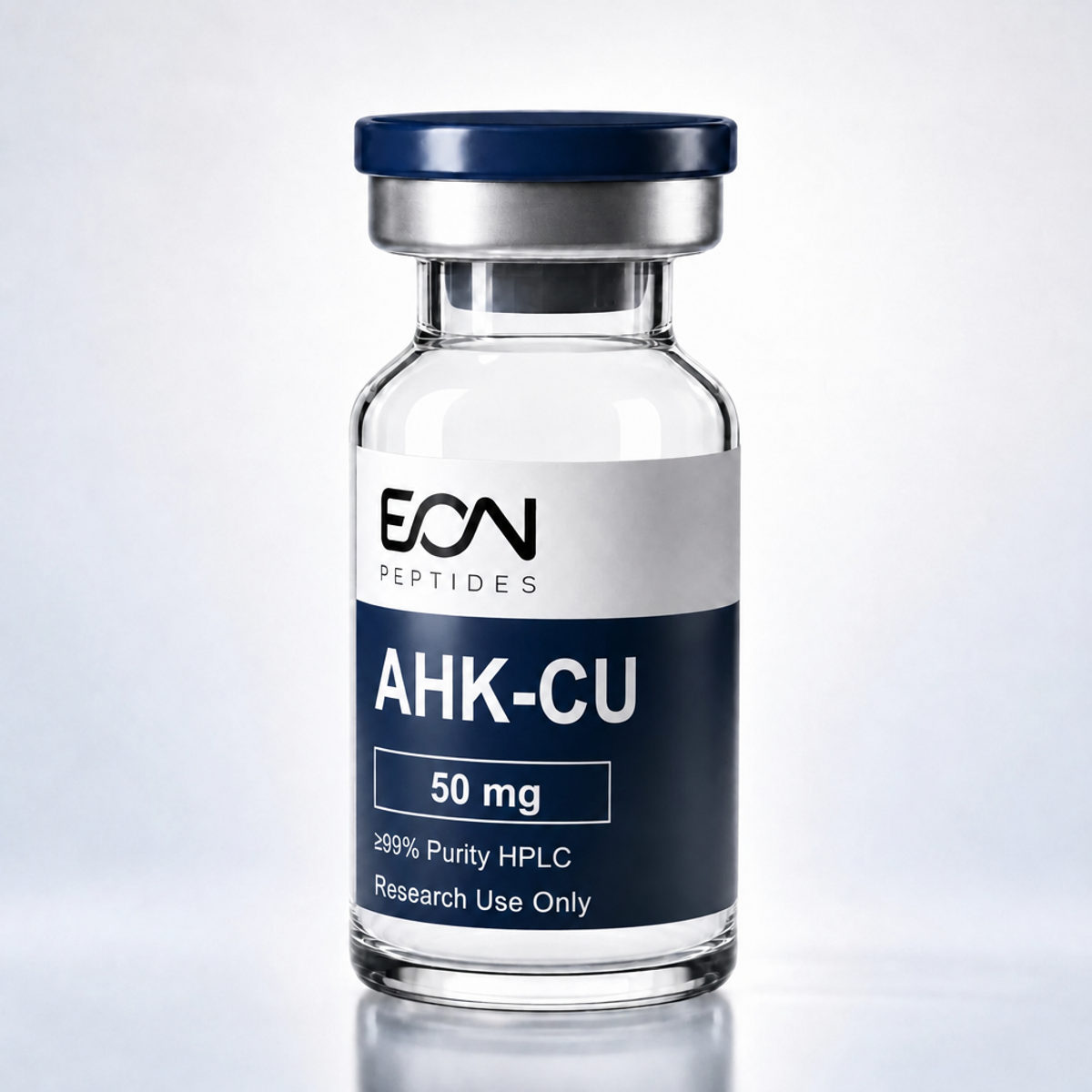
Molecular data
| Sequence | Ala-His-Lys (copper complex) |
|---|---|
| Sequence length | 3 residues |
| Physical form | Lyophilized powder |
| Available sizes | 50mg |
How it works
-
Structure
Copper-Binding Tripeptide
AHK forms a complex with copper(II) in the same family as GHK-Cu. Copper-transport behaviour is the shared characterised property across the copper-peptide class.
- Ala-His-Lys backbone
- Copper(II) complex
- Copper transport behaviour
-
Cellular
Follicle and Papilla Models
Dermal papilla cell culture is the principal model in the published AHK-Cu literature, with proliferation endpoints measured.
- Dermal papilla culture
- Proliferation endpoints
- Follicle research context
-
Signalling
Growth Factor Expression
Vascular endothelial growth factor expression is a recurring measured endpoint in copper-peptide culture work.
- VEGF expression
- Culture models
- Dose-response characterisation
What the research shows
-
Dermatology
Follicle Models
Dermal papilla cell culture is the principal published model for AHK-Cu.
-
Cell Biology
Growth Factor Expression
VEGF expression in culture is a recurring measured endpoint.
-
Biochemistry
Copper Transport
Studied alongside GHK-Cu as part of the copper-peptide class.
-
Analytical
Reference Material
Used as a characterised copper-peptide reference in comparative work.
Specification
| Chemical Name | AHK-Cu (Ala-His-Lys copper complex) |
|---|---|
| Sequence | Ala-His-Lys |
| Content | 50 mg per vial |
| Class | Copper-binding tripeptide |
| Form | Lyophilized powder |
| Purity | ≥99% by HPLC |
| Appearance | Blue to blue-violet powder |
| Solubility | Water-soluble |
| Storage | -20°C, protected from light |
| Classification | Research use only |
Frequently asked questions
How does AHK-Cu differ from GHK-Cu?
Both are copper-binding tripeptides, but the sequences differ: AHK is Ala-His-Lys and GHK is Gly-His-Lys. AHK-Cu's published literature focuses on follicle and dermal papilla models.
Is a molecular weight listed?
The molecular weight will be published here from the lot's Certificate of Analysis rather than quoted from a secondary source.
Why is the powder blue?
Copper-peptide complexes are characteristically blue to blue-violet. The colour comes from the copper(II) coordination.
What purity is documented?
Each lot is analysed by reverse-phase HPLC and released at ≥99%, with a Certificate of Analysis.
How is it stored?
Store lyophilized at -20°C for long-term stability, protected from light and moisture, and avoid repeated freeze-thaw cycles.
Related monographs
For laboratory research use only. Not a drug, supplement, or medical product; not for human or animal use. All findings referenced are from published preclinical/laboratory research.