
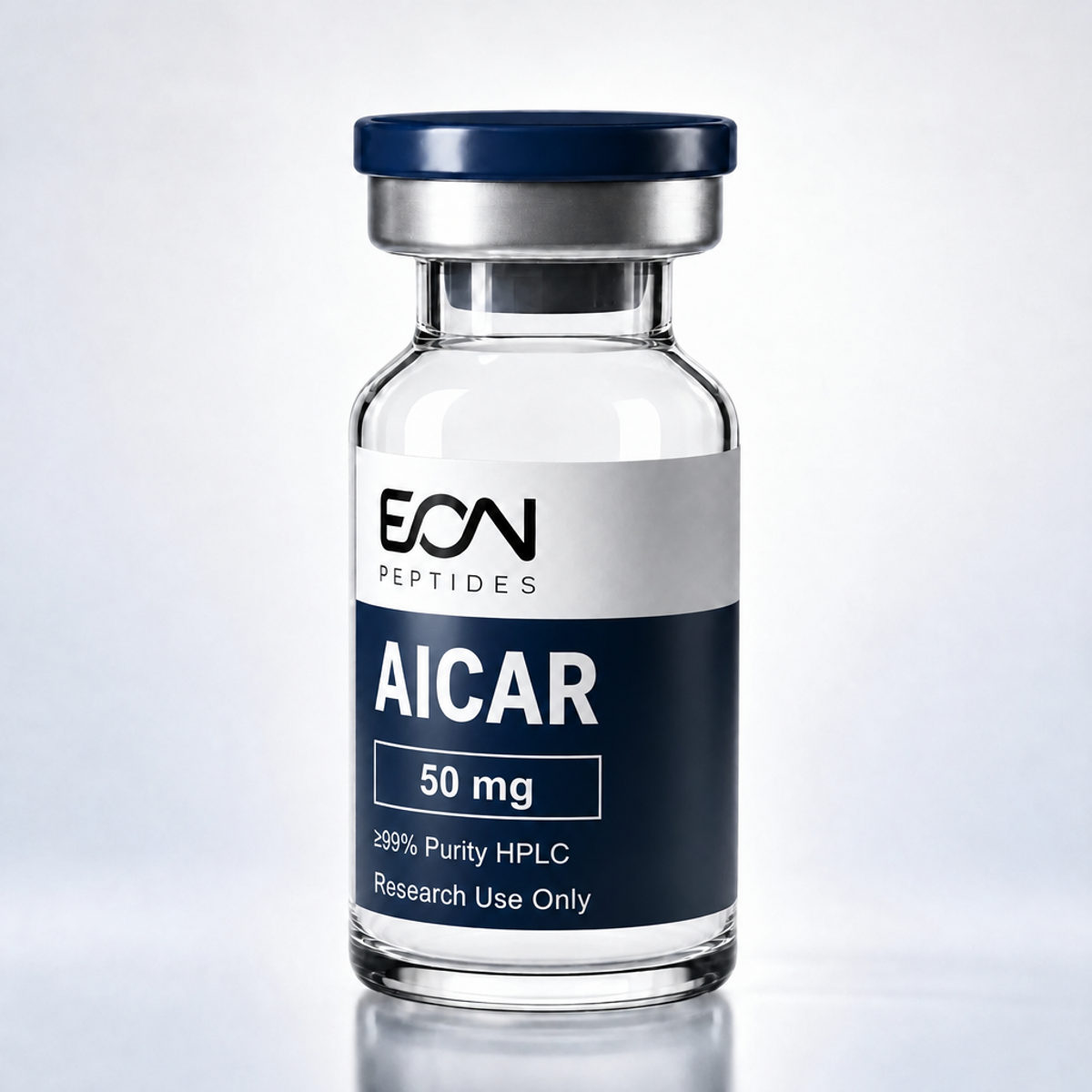
Molecular data
| Physical form | Lyophilized powder |
|---|---|
| Available sizes | 50mg |
How it works
-
Metabolism
Intracellular Conversion to ZMP
AICAR is taken up by adenosine transporters and phosphorylated to ZMP. ZMP mimics AMP and allosterically activates AMPK without changing cellular AMP levels, which is what makes AICAR a standard pharmacological tool.
- Adenosine transporter uptake
- Phosphorylation to ZMP
- AMP-mimetic activation
-
Signalling
AMPK Pathway Activation
AMPK activation is measured by phosphorylation of downstream substrates including acetyl-CoA carboxylase. Glucose-uptake and fatty-acid-oxidation endpoints follow in the characterised literature.
- ACC phosphorylation
- Glucose uptake endpoints
- Fatty-acid oxidation
-
Cellular
Mitochondrial Biogenesis
Downstream PGC-1α signalling and mitochondrial biogenesis endpoints are characterised in skeletal muscle models.
- PGC-1α signalling
- Mitochondrial biogenesis
- Skeletal muscle models
What the research shows
-
Metabolic
AMPK Pathway Research
AICAR is one of the standard pharmacological AMPK activators used as a positive control in pathway work.
-
Metabolic
Glucose Uptake Models
Glucose-uptake endpoints in skeletal muscle culture are widely characterised.
-
Cell Biology
Mitochondrial Biogenesis
PGC-1α signalling and biogenesis endpoints are measured downstream of AMPK activation.
-
Analytical
Reference Compound
Frequently used as a characterised reference activator in assay development.
Specification
| Chemical Name | AICAR (5-aminoimidazole-4-carboxamide ribonucleoside) |
|---|---|
| Class | Adenosine analog / AMPK activator |
| Content | 50 mg per vial |
| Active Metabolite | ZMP (AMP mimetic) |
| Pathway Target | AMP-activated protein kinase (AMPK) |
| Form | Lyophilized powder |
| Purity | ≥99% by HPLC |
| Solubility | Water, DMSO |
| Storage | -20°C, protected from light |
| Classification | Research use only |
Frequently asked questions
What makes AICAR a standard AMPK tool?
It is converted intracellularly to ZMP, which mimics AMP and activates AMPK allosterically without altering the cell's actual AMP levels. That lets a protocol activate the pathway pharmacologically.
Is AICAR a peptide?
No. It is a small-molecule adenosine analog, not a peptide. It is included here as a metabolic-research reference compound.
Is a molecular weight listed?
The molecular weight will be published here from the lot's Certificate of Analysis rather than quoted from a secondary source.
What purity is documented?
Each lot is analysed by reverse-phase HPLC and released at ≥99%, with a Certificate of Analysis.
How is it stored?
Store lyophilized at -20°C for long-term stability, protected from light and moisture, and avoid repeated freeze-thaw cycles.
Related monographs
For laboratory research use only. Not a drug, supplement, or medical product; not for human or animal use. All findings referenced are from published preclinical/laboratory research.