
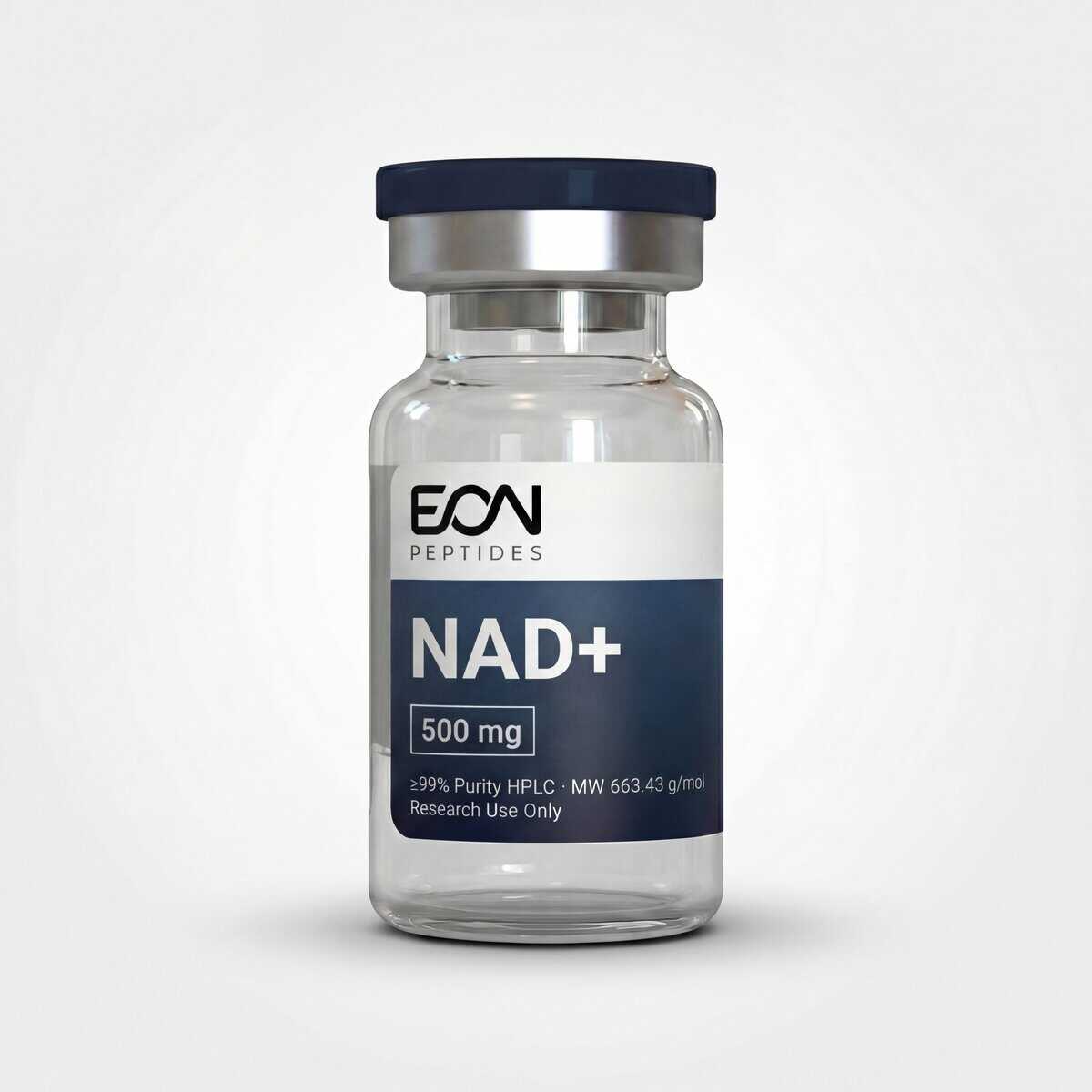
Molecular data
| Molecular formula | C₂₁H₂₇N₇O₁₄P₂ |
|---|---|
| Molecular weight | 663.43 Da |
| CAS / identifier | 53-84-9 |
| Physical form | Lyophilized powder |
| Available sizes | 100mg, 500mg, 1000mg |
How it works
-
Bioenergetics
Role in the Mitochondrion
The mitochondrial electron transport chain cannot operate without NAD+, which takes a direct part in turning nutrients into ATP, the energy currency of the cell. Mitochondrial efficiency is impaired when NAD+ levels fall.
- Oxidative phosphorylation depends on it
- Carries electrons between metabolic reactions
- Serves as co-substrate for more than 500 enzymatic reactions
-
Sirtuins
Co-Substrate for Sirtuin Enzymes
All 7 sirtuin enzymes (SIRT1-7) require NAD+ as an obligate co-substrate. These enzymes regulate metabolic homeostasis, stress resistance, inflammation and aging, and they cannot function when NAD+ is absent.
- All 7 sirtuin enzymes are activated by it
- Stress response and aging come under its regulation
- Inflammatory pathways are modulated
-
Genome Maintenance
PARP Enzymes and Genomic Stability
Repair of DNA damage by PARP enzymes uses up NAD+. The age-related fall in NAD+ is associated with genomic instability, cellular senescence and a reduced capacity for DNA repair.
- DNA repair through PARP is fuelled by it
- Genomic stability is maintained
- Acts against DNA damage linked to age
What the research shows
-
Longevity Models
Senescence and Aging Studies
In several model organisms, exposure to NAD+ has been followed by recorded lifespan extension. The same studies measured mitochondrial function and activity of the sirtuin pathway.
-
Metabolism
Cellular Energy Metabolism
A pseudohypoxic state and disrupted communication between nucleus and mitochondria are both associated with falling NAD+. Animal model work has recorded shifts in age-related metabolic markers when NAD+ levels were raised.
-
Genome
Repair of DNA
The PARP enzymes that repair single-strand DNA breaks run on NAD+. When it is depleted, DNA damage accumulates and cellular aging accelerates.
-
Mitochondria
Activation of UPRmt
Ageing research studies the mitochondrial unfolded protein response (UPRmt), a stress-response mechanism that is engaged by the NAD+/sirtuin pathway.
How it's tested
Every lot of NAD+ released to the catalog carries a third-party certificate of analysis. 11 documented lots are on file for this compound, with reported HPLC purity from 99.40% to 99.98% (mean 99.85%), issued by Accurate Test Labs and Freedom Diagnostics. 8 of 11 certificates record identity as confirmed.
- Documented lots
- 11
- Reported purity
- 99.40% to 99.98%
- Mean purity
- 99.85%
- Issuing labs
- Accurate Test Labs, Freedom Diagnostics
- 2026-09-15 Lot NAD-091126-1000Accurate Test Labs 99.75% View certificate
- 2026-08-17 Lot Auth2608070236Freedom Diagnostics 99.98% View certificate
- 2026-08-14 Lot NJ100-WM2607-001Accurate Test Labs 99.74% View certificate
Frequently asked questions
How is NAD+ classified and what functions does it serve in the cell?
Nicotinamide Adenine Dinucleotide (NAD+) is an essential coenzyme present in every living cell. More than 500 enzymatic reactions involve it, and cellular signaling, DNA repair and energy metabolism all depend on it. Levels fall naturally with age, and researchers believe that this fall contributes to metabolic dysfunction associated with age.
What does the literature report about NAD+ levels and age?
By age 50, NAD+ levels have fallen by roughly 50%. This decline tracks with DNA repair capacity, the activity of sirtuin enzymes and mitochondrial function. Work in animal models has recorded shifts in some age-related markers when NAD+ levels were raised.
Why is sirtuin activity dependent on NAD+?
The sirtuins (SIRT1-7) form an enzyme family studied in stress resistance, inflammation, metabolism and ageing. NAD+ is their co-substrate and their dependence on it is complete: sirtuins cannot function when NAD+ is insufficient.
How are NAD+, NMN and NR related biochemically?
NAD+ is the active coenzyme. Nicotinamide Mononucleotide (NMN) and Nicotinamide Riboside (NR) are both precursors, and cells must convert them into NAD+ using their own enzymes. Direct application of NAD+ skips those conversion steps.
What is known about the storage stability of NAD+?
For long-term stability, the lyophilized form is kept at -20°C. Heat and light both degrade NAD+, so the material must always be shielded from direct light.
Related monographs
For laboratory research use only. Not a drug, supplement, or medical product; not for human or animal use. All findings referenced are from published preclinical/laboratory research.