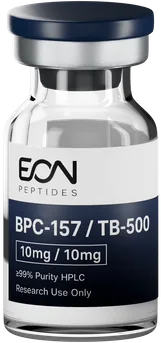
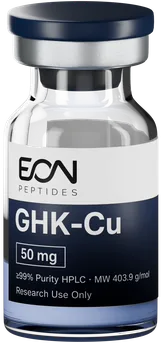
Dermal Models
GHK-Cu is studied for collagen synthesis; BPC-157 and TB-500 in epithelial and scarring models.


GHK-Cu-weighted blend · dermal and matrix models
Free Shipping on orders over $200
Scan the QR code on any vial to verify its batch, COA, and origin in seconds. Secure traceability from our lab to your bench.
Researchers also added
Research use only.
GLOW+ is the higher-strength GLOW blend: 100 mg GHK-Cu with 10 mg BPC-157 and 10 mg TB-500, freeze-dried together in a single 120 mg vial. The three peptides are studied in skin and connective tissue models, covering collagen production, tissue structure, and how skin cells move and multiply. It is supplied for researchers testing several pathways together rather than one at a time.
Three-peptide research blend: GHK-Cu 100mg + BPC-157 10mg + TB-500 10mg
The numbers that define GLOW+ and how it is being studied. For laboratory research use only.
VEGF + Actin + Collagen
Tendon fibroblast culture, day 3
Up- or down-regulated in human cell lines
Keratinocytes in a Boyden chamber assay
The pathways GLOW+ acts on - and what each one does. The animation traces its signal outward from the compound to every target it engages.
Vessel formation, tissue granulation and nitric oxide signalling have been measured as endpoints in preclinical models.
Cell migration, cytoskeletal remodelling and fibrotic scarring are measured via the thymosin beta-4 pathway.
Type I and III collagen synthesis measured, expression changes reported across 4,000+ genes, and copper delivered to tissue during extracellular matrix turnover.
The main areas GLOW+ is being studied for - and the study-reported figures behind them.
GHK-Cu is studied for collagen synthesis; BPC-157 and TB-500 in epithelial and scarring models.
TB-500 is characterised for actin remodelling; tendon fibroblast viability is measured for BPC-157; vascularisation endpoints for GHK-Cu.
All three peptides demonstrate anti-inflammatory properties through different mechanisms in animal models.
Extracellular matrix deposition and fibrotic scoring as combined endpoints.
An interactive 3D model rendered from the compound record - rotate and explore its structure.
Molecular model
| Components | GHK-Cu 100mg + BPC-157 10mg + TB-500 10mg |
| Strength | 120mg |
| Form | Lyophilized powder |
| Purity | ≥99% by HPLC-UV (99.89% on lot 377PG1) |
| Testing | Third-party HPLC-UV purity, LC-MS identity, net content per peptide |
| Storage | -20°C for long-term stability |
| Light sensitivity | Protect from direct light at all times |
| Solubility | Water-soluble |
| COA | Included with every order |
| Appearance | Blue lyophilized powder |
| Stability | 24 months from manufacture date when stored properly |
GLOW+ is a research peptide blend of three peptides in one 120 mg vial: 100 mg GHK-Cu (copper peptide), 10 mg BPC-157 (Body Protection Compound) and 10 mg TB-500 (Thymosin Beta-4). Each is characterised on a different pathway: collagen synthesis, vascular, and cell migration respectively.
Same three peptides, different strength. GLOW+ is a 120 mg vial weighted toward GHK-Cu (100 mg), with 10 mg each of BPC-157 and TB-500. GLOW is the 70 mg vial.
In preclinical research, vessel formation (angiogenesis) is measured for BPC-157, cell migration via actin regulation for TB-500, and collagen production plus expression changes across 4,000+ genes for GHK-Cu. The three cover distinct pathways, which is the rationale for combining them.
No. GLOW+ is not approved by the FDA for any medical use. It is sold exclusively for in vitro laboratory research purposes. The individual components have varying levels of preclinical evidence but no completed human clinical trials for the combined blend.
Store lyophilized (powder) form at -20°C for maximum stability. Protect from direct light at all times and avoid repeated freeze-thaw cycles.
Every lot is tested by an independent US laboratory: HPLC-UV for purity, LC-MS to confirm the identity of each peptide, and net content per peptide. The current lot (377PG1) reads 99.89% purity with GHK-Cu 95.78 mg, BPC-157 10.43 mg and Thymosin Beta-4 9.85 mg per vial. The certificate is linked on this page.
The rationale is based on individual component research in preclinical models. The combined blend has not been characterised as a single formulation. Complementarity is inferred from mechanism.
Not for human or veterinary use. For in-vitro laboratory research only. These statements have not been evaluated by the FDA; this product is not intended to diagnose, treat, cure, or prevent any disease. Sold exclusively to qualified researchers and institutions.