Pulsatile GH Research
Short half-life makes CJC-1295 no-DAC the preferred GHRH analog for studying discrete GH pulse dynamics - allowing researchers to precisely time and measure individual GH pulses.


GH Half-Life Studies
Free Shipping on orders over $200
Scan the QR code on any vial to verify its batch, COA, and origin in seconds. Secure traceability from our lab to your bench.
Researchers also added
Research use only.
The Eon standard
Your results are only as good as your compound.
Every lot of CJC-1295 is tested by an independent ISO/IEC 17025-accredited lab in the USA. 99%+ purity isn't a target here. It's the requirement.
Don't take our word for it: test any vial at an accredited lab of your choice. If HPLC purity comes back under 99%, we refund your order and pay for the test.
CJC-1295 without DAC is a modified version of GHRH, the hormone that signals growth hormone release. Four amino acids are swapped to slow down enzyme breakdown. It carries no albumin linker. Because it clears quickly, researchers use this version when the timing of a signal is what they are measuring. It also serves as the comparison point against the DAC version.
Modified GRF(1-29), protease-resistant synthetic GHRH(1-29) analog (no albumin-binding DAC)
The numbers that define CJC-1295 and how it is being studied. For laboratory research use only.
4 amino acid substitutions for protease resistance
D-Ala2 GRF(1-29), against 4.3 min unmodified
Effect of the D-Ala2 substitution on clearance
The pathways CJC-1295 acts on - and what each one does. The animation traces its signal outward from the compound to every target it engages.
CJC-1295 (without DAC) is a synthetic analog of GHRH(1-29) with four amino acid substitutions at positions 2, 8, 15, and 27 that confer resistance to DPP-IV and other plasma proteases. It binds and activates GHRH receptors on pituitary somatotrophs with high affinity, mimicking the action of endogenous GHRH.
Unlike CJC-1295 DAC, the no-DAC version has a ~30-minute half-life, producing discrete GH pulses rather than sustained elevation. This pulsatile pattern closely mirrors physiological GH secretion, which occurs in 6-12 pulses per day. Research protocols utilize this property to study natural GH pulse dynamics.
Each GH pulse drives transient hepatic IGF-1 production. Unlike the prolonged IGF-1 elevation seen with CJC-1295 DAC, the no-DAC version produces IGF-1 responses timed to each GH pulse, allowing more controlled study of GH pulse-to-IGF-1 relationships in research protocols.
The main areas CJC-1295 is being studied for - and the study-reported figures behind them.
Short half-life makes CJC-1295 no-DAC the preferred GHRH analog for studying discrete GH pulse dynamics - allowing researchers to precisely time and measure individual GH pulses.
Used as a reference standard in comparative studies evaluating GHRH analog pharmacokinetics, receptor binding, and downstream GH/IGF-1 axis responses versus native GHRH and DAC-modified variants.
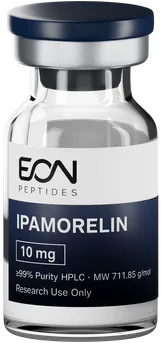
GHRH-R (CJC-1295) and GHSR-1a (ipamorelin) act on complementary pituitary pathways. Combined protocols are studied for additive GH pulse amplitude without cortisol or prolactin co-elevation.
Modified GRF(1-29) used in GHRH-deficient and age-related GH decline animal models to study GHRH receptor replacement activity and GH secretory capacity.
An interactive 3D model rendered from the compound record - rotate and explore its structure.
C152H252N44O42
How CJC-1295 clears from circulation, modeled from its documented ~~20-30 minutes half-life. The curve draws as you scroll.
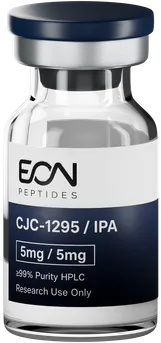
| Strength | 5mg |
| Molecular Formula | C152H252N44O42 |
| Molecular Weight | 3367.97 g/mol |
| Purity | >99% (HPLC) |
| Form | Lyophilized Powder |
| Also Known As | Modified GRF(1-29), Mod GRF, CJC-1295 no DAC |
| Type | Synthetic GHRH analog - no albumin-binding modification |
| CAS Number | 863288-34-0 (base peptide, no DAC) |
| Amino Acids | 29 (GHRH 1-29 analog, 4 substitutions) |
| Key Substitutions | Ala²→Aib, Arg8→Gln, Ala15→Aib, Leu27→Leu (various sources vary) |
| Plasma Half-Life | ~20-30 minutes |
| Testing | Third-party HPLC, Mass Spec, Endotoxin |
| Storage | -20°C for up to 24 months |
| Solubility | Water-soluble |
| COA | Included with every order |
| Appearance | White to off-white powder |
CJC-1295 without DAC - also called Modified GRF(1-29) or Mod GRF - is a synthetic 29-amino acid analog of growth hormone-releasing hormone (GHRH). It incorporates four amino acid substitutions that resist DPP-IV protease cleavage, extending the half-life from ~7 minutes (native GHRH) to approximately 20-30 minutes. Unlike CJC-1295 DAC, it does not contain the albumin-binding Drug Affinity Complex (DAC) modification, so it produces pulsatile rather than sustained GH stimulation.
The sole structural difference is the presence or absence of the Drug Affinity Complex (DAC) - a maleimidopropionic acid group on Lys8. Without DAC: half-life ~30 minutes, produces discrete GH pulses, requires frequent administration for a sustained signal, mirrors physiological GH pulse patterns. With DAC: half-life 5.8-8.1 days via albumin binding, produces sustained GH/IGF-1 elevation, enables extended-interval administration in research protocols.
Endogenous growth hormone is secreted in 6-12 discrete pulses per day from the anterior pituitary, primarily during slow-wave sleep. Pulsatile GH secretion is associated with differential downstream effects compared to continuous exposure - affecting IGF-1 production, receptor sensitivity, and anabolic signaling differently. CJC-1295 without DAC's short half-life makes it useful for research protocols that need to preserve or study this physiological pulsatile pattern, rather than maintaining continuous elevated GH.
CJC-1295 (no DAC) activates GHRH receptors (GHRH-R) on pituitary somatotrophs, while ipamorelin activates Growth Hormone Secretagogue Receptor 1a (GHSR-1a). These are distinct receptor systems working through complementary intracellular pathways. When both are activated simultaneously, GH pulse amplitude above either compound alone has been recorded. That additive interaction is the rationale behind the CJC-1295/Ipamorelin research blend.
No. CJC-1295 without DAC is not FDA-approved for any indication. It is a research compound available for in vitro laboratory use only. No standalone Phase 3 clinical trials have been completed for this specific form. It is not intended for human therapeutic use.
Lyophilized (powder) form should be stored at -20°C for long-term stability. Avoid repeated freeze-thaw cycles and protect from light. The absence of the DAC modification means the peptide is more susceptible to DPP-IV degradation in solution, so the lyophilized material is the more stable form.
Not for human or veterinary use. For in-vitro laboratory research only. These statements have not been evaluated by the FDA; this product is not intended to diagnose, treat, cure, or prevent any disease. Sold exclusively to qualified researchers and institutions.