99%+ HPLC purityThird-party testedCOA with every lotMass-spec confirmed identityISO/IEC 17025 labsEndotoxin screenedSame-day dispatch · tracked
Lab testing · A to Z
How every Eon lotgets tested.
Every lot Eon ships is tested by an independent laboratory, not by us. This page follows one real certificate from start to finish: what the lab checks, how each test works, and how to open the result for the vial in your hands.
Six stages, in the order they happen. Nothing on this list is done by Eon alone: the testing and the certificate come from the laboratory, and the certificate is published exactly as the lab issued it.
A · Stage 01
The lot
A batch of compound is made, dried to a lyophilized powder and sealed in vials. Every vial from that batch shares one lot and one certificate.
Stage 02
Sent to an independent lab
Sealed vials from the lot go to an independent third-party laboratory. The lab is named on the certificate, and so is the client: Eon Peptides.
Stage 03
The test panel
The lab confirms identity, measures purity and net content, and runs the safety screens it is asked for: endotoxin, heavy metals and microbial DNA.
The lab issues a Certificate of Analysis with its own accession number, the methods used and every result. For the NAD+ lot below: received Sep 25, 2026, reported Sep 27, 2026.
Stage 05
Published in full
The complete PDF goes into the public COA library, filed beside every earlier certificate for the same compound, so lots can be compared side by side.
Z · Stage 06
On your vial
Scan the QR code on the vial; it opens the certificate for that exact lot. Or look the batch up on the verification page.
02The test panel
Six tests, one real certificate
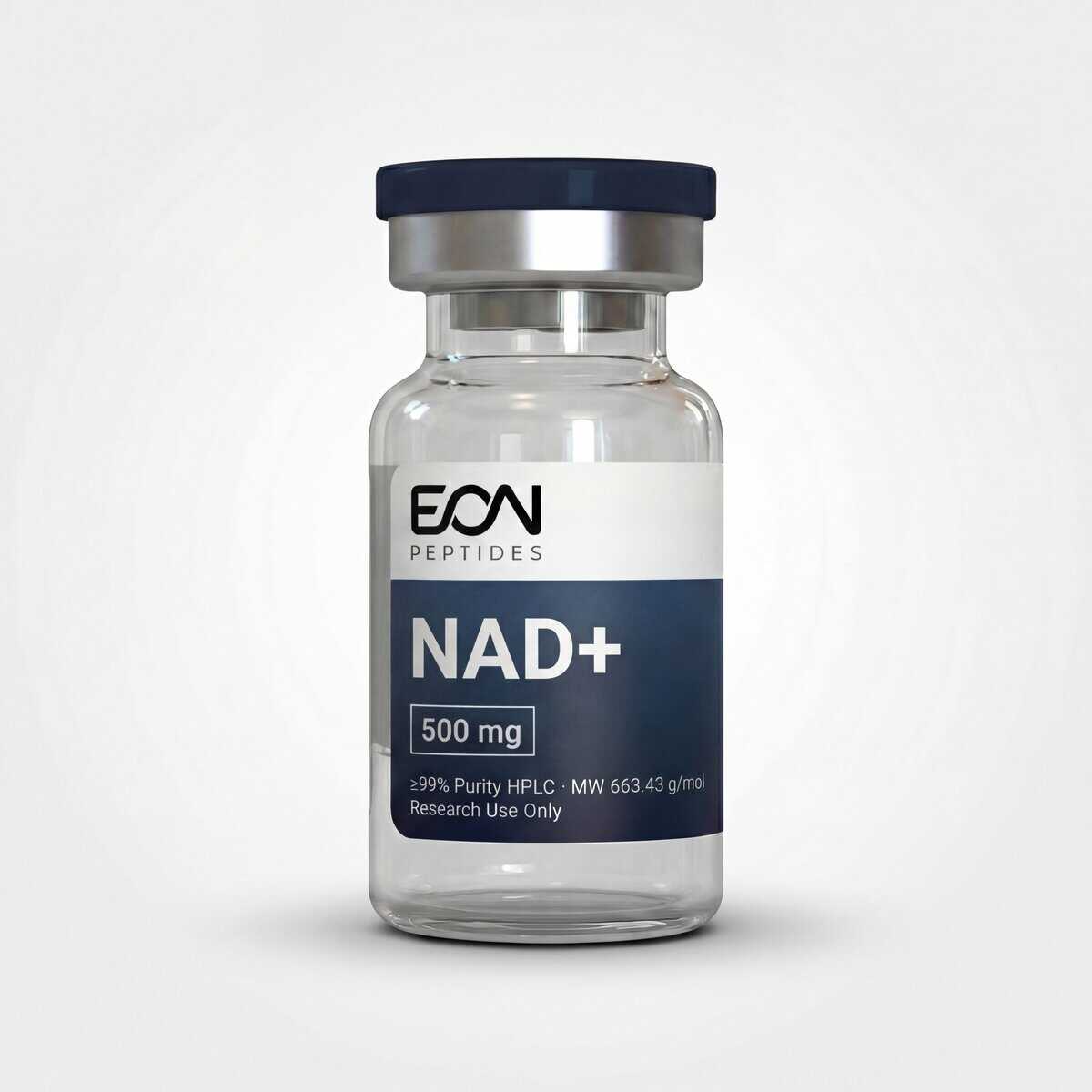
Follow an actual report as it fills in: NAD+ 500mg, tested by Freedom Diagnostics and reported Sep 27, 2026. Each test below adds its line to the certificate.
Test 01 · Identity
Is it the compound on the label?
Liquid chromatography separates the sample, then a mass spectrometer measures the mass of the molecules coming off the column. The measured mass has to land on the known mass of the compound. If it does, identity is confirmed; if a different molecule is in the vial, its mass gives it away.
Illustrative spectrum · the real mass trace is printed on the certificate
Method
LC-MS (liquid chromatography with mass spectrometry)
On this certificate
Identity (LC-MS): Confirmed
Reported on every certificate in the archive.
Test 02 · Purity
How much of it is the target compound?
The dissolved sample is pushed through a packed column. Each component travels at its own speed and leaves at its own time, drawing a peak on the UV detector. Purity is the main peak's area as a share of the area of every peak: anything else in the vial shows up as a second peak and pulls the number down.
Purity = main peak area ÷ total peak area · illustrative trace
Method
HPLC with UV detection
On this certificate
Purity (HPLC-UV): 99.54%
Reported on every certificate in the archive.
Test 03 · Net content
How much compound is in the vial?
Purity says what share of the material is the compound; net content says how much of it there is. The lab measures known amounts of a reference standard to build a calibration line, then reads the sample against that line and reports the result in milligrams.
Reference standards (open) set the line; the sample (filled) is read off it · illustrative
Method
Quantitation against a reference standard
On this certificate
Net content, reported in mg
Reported on every certificate in the archive.
Test 04 · Endotoxin
Are bacterial endotoxins present?
Endotoxins are fragments of bacterial cell walls (lipopolysaccharide). They survive heat and filtration, and even trace amounts can skew cell-based and other in-vitro work. The Limulus Amebocyte Lysate (LAL) assay uses a reagent from horseshoe crab blood cells that reacts to endotoxin at very low levels. The lab runs it in two replicates; both must pass.
A spiked control must react, proving the assay can see endotoxin · illustrative
Method
LAL assay per USP <85>, two replicates, sensitivity 0.05 EU/mL
On this certificate
Endotoxin: Pass, both replicates
Printed on the certificate wherever the lab ran it. Recent certificates with an endotoxin result:
Test 05 · Heavy metals
Are toxic elements present?
ICP-MS feeds the sample into an argon plasma hot enough to break it into individual ions, then counts each element by its mass. The panel covers the four elements of most concern: arsenic, cadmium, lead and mercury. Each has a limit; a result of ND means the instrument found none above what it can detect.
Limits and results as printed on an Accurate Test Labs certificate (BPC-157 / TB-500 20mg, Sep 23, 2026) · ND = not detected
Method
ICP-MS (inductively coupled plasma mass spectrometry)
On this certificate
Elemental impurities: Pass, As, Cd, Pb and Hg below limits
Printed on the certificate wherever the lab ran it. Recent certificates with a heavy-metal panel:
Test 06 · Microbial
Is there microbial contamination?
PCR copies a target stretch of DNA over and over, cycle after cycle. If microbes are in the sample, their DNA multiplies until the signal crosses a threshold. If nothing crosses it, there is no detectable microbial DNA.
Illustrative amplification plot
Method
PCR-based assay for common microbial contaminants
On this certificate
Microbial: No detectable microbial DNA
Printed on the certificate wherever the lab ran it. Recent certificates with a microbial screen:
Every documented HPLC purity on file, plotted. The lowest result in the archive is 99.00%; the average across 195 lots is 99.71%. If a lot does not match the identity and purity on its certificate, it is refunded or replaced.
Tested at
Documented HPLC purity, lots per 0.1% band · recalculated from the archive on every visit
Independent third-party laboratories, not Eon Peptides. The issuing laboratory is printed on every certificate, along with the lab's own accession number. Laboratories in the current archive: Freedom Diagnostics, Accurate Test Labs, pH Solutions.
Does every certificate include endotoxin, heavy metal and microbial results?
Not every one, and we would rather say so plainly. Identity, purity and net content are reported on every certificate in the archive. Endotoxin, heavy metal and microbial screens appear on the certificates where the laboratory ran them, and each result is printed on that certificate. The examples in the test panel above open real reports with each screen.
What does USP <85> mean on a certificate?
USP <85> is the United States Pharmacopeia chapter that defines the bacterial endotoxins test using Limulus Amebocyte Lysate (LAL). A certificate that cites it states the laboratory followed that standard method. The endotoxin results in this archive report two replicates with an assay sensitivity of 0.05 EU/mL.
What is the lowest purity in the archive?
99.00%. Every documented HPLC purity on file is 99% or higher, and the average across 195 lots is 99.71%. 9 certificates are scanned images without a machine-readable purity value; they are published in full but left out of the averages.
How do I find the certificate for my vial?
Scan the QR code on the vial; it opens the certificate for that exact lot. You can also look the batch up on the verification page, or browse every certificate by compound in the COA library.
Are these products for human or veterinary use?
No. Every Eon product is sold for laboratory research use only. The tests on this page document what is in the vial; they are not an approval for human or animal use, and the products are not drugs, foods, dietary supplements or cosmetics.
Every certificate, in the open.
204 certificates from independent laboratories, published in full. For laboratory research use only.