
The molecule, in three dimensions
- Heavy atoms
- 238
- Bonds
- 240
- Composition
- C152 N44 O42
- Rings
- 3
- Metal centre
- None
- Chain length
- 29 residues
Every heavy atom is placed from the sequence with ideal bond lengths and angles, so the connectivity is exact. The pose is idealised, an ideal helix, and is not a measured conformation. Identity for the lot in stock is confirmed by LC-MS on its certificate.
Molecular data
| Molecular formula | C152H252N44O42 |
|---|---|
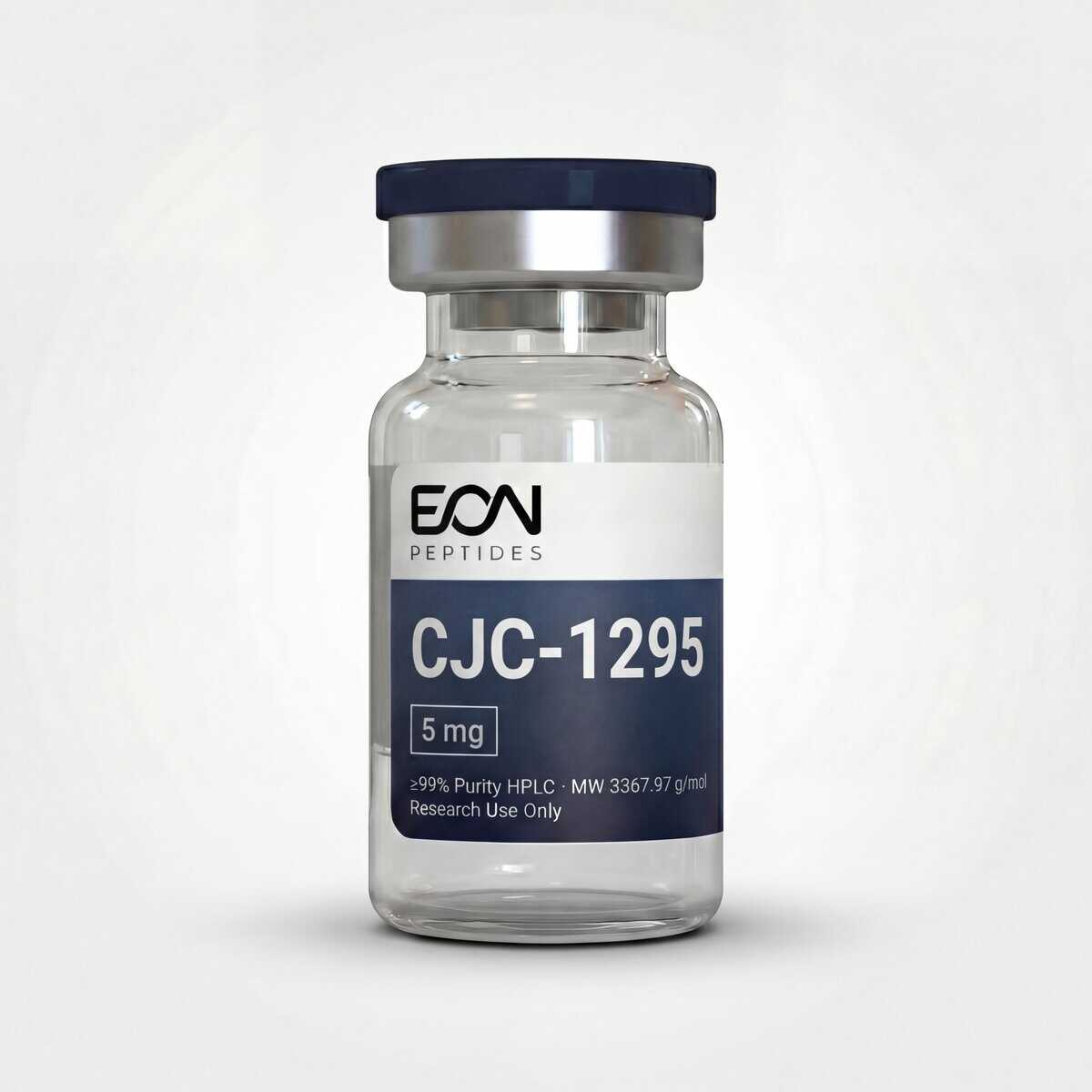
| Molecular weight | 3367.97 Da |
| Sequence | Tyr-D-Ala-Asp-Ala-Ile-Phe-Thr-Gln-Ser-Tyr-Arg-Lys-Val-Leu-Ala-Gln-Leu-Ser-Ala-Arg-Lys-Leu-Leu-Gln-Asp-Ile-Leu-Ser-Arg |
| Sequence length | 29 residues |
| CAS / identifier | 863288-34-0 |
| Physical form | Lyophilized Powder |
| Available sizes | 5mg |
How it works
-
Receptor Agonism
Activation of the GHRH Receptor
CJC-1295 (without DAC) is a synthetic GHRH(1-29) analog. Substitutions at four amino acid positions - 2, 8, 15 and 27 - make it resistant to plasma proteases, DPP-IV among them. It acts as endogenous GHRH does: the peptide binds with high affinity to GHRH receptors on somatotrophs of the pituitary and activates them.
- Agonist selective for GHRH-R, the GHRH receptor
- Aib in place of Ala at position 2 gives DPP-IV resistance
- Binds pituitary somatotrophs with high affinity
-
GH Pulses
Secretion of GH in Pulses
With its ~30-minute half-life, the no-DAC form differs from CJC-1295 DAC by yielding separate GH pulses, not a sustained rise. Physiological GH secretion runs at 6-12 pulses per day, a pattern this closely resembles. Research protocols use the property to examine natural GH pulse dynamics.
- No albumin binding; half-life of ~30 minutes
- Yields separate GH pulses of physiologic form
- GH response peaks at 15-30 minutes
-
IGF-1 Response
Response of the GH/IGF-1 Axis
Hepatic IGF-1 production rises transiently after every GH pulse. Where CJC-1295 DAC gives prolonged IGF-1 elevation, the no-DAC form gives IGF-1 responses that track each exposure, so research protocols can examine the GH pulse-to-IGF-1 relationship under tighter control.
- Each GH pulse brings a transient IGF-1 rise
- Prolactin and cortisol are not elevated
- Synergy with GH secretagogues such as ipamorelin
What the research shows
-
Endocrine Studies
Studying GH Pulses
Its short half-life makes the no-DAC form the GHRH analog of choice where discrete GH pulse dynamics are the subject: individual pulses can be timed and measured precisely.
-
Comparative Pharmacology
Comparing GHRH Analogs
A reference standard in comparative studies that evaluate GHRH analogs on receptor binding, pharmacokinetics and downstream GH/IGF-1 axis response, set against DAC-modified variants and native GHRH.
-
Paired Compounds
Synergy of CJC-1295 with Ipamorelin
CJC-1295 (GHRH-R) and ipamorelin (GHSR-1a) engage complementary pituitary pathways. Combined protocols are examined for additive GH pulse amplitude with no co-elevation of prolactin or cortisol.
-
In Vivo Models
Models of the GHRH Axis
Animal models of GHRH deficiency and age-related GH decline employ Modified GRF(1-29) to study GH secretory capacity and replacement of GHRH receptor activity.
How it's tested
Every lot of CJC-1295 released to the catalog carries a third-party certificate of analysis. 4 documented lots are on file for this compound, with reported HPLC purity from 99.18% to 99.92% (mean 99.53%), issued by Accurate Test Labs and Freedom Diagnostics. 3 of 4 certificates record identity as confirmed.
- Documented lots
- 4
- Reported purity
- 99.18% to 99.92%
- Mean purity
- 99.53%
- Issuing labs
- Accurate Test Labs, Freedom Diagnostics
- 2026-09-15 Lot CJC-091126-5Accurate Test Labs 99.18% View certificate
- 2026-05-11 Lot Auth2605110189Freedom Diagnostics 99.72% View certificate
- 2026-02-18 Lot 700001Freedom Diagnostics 99.919% View certificate
Frequently asked questions
How is CJC-1295 without DAC (Modified GRF 1-29) classified and structured?
Known also as Mod GRF or Modified GRF(1-29), CJC-1295 without DAC is classified as a synthetic 29-residue analog of GHRH (growth hormone-releasing hormone). Four of its positions carry substitutions that resist cleavage by the protease DPP-IV, which moves the half-life from about 7 minutes for native GHRH to roughly 20-30 minutes. The Drug Affinity Complex (DAC), the albumin-binding modification present in CJC-1295 DAC, is absent here, and GH stimulation is therefore pulsatile and not sustained.
What structural feature separates the no-DAC form from CJC-1295 DAC, and what follows from it?
One structural feature separates them: whether the Drug Affinity Complex (DAC), a maleimidopropionic acid group carried on Lys8, is present. The form lacking DAC has a ~30 minute half-life, gives discrete GH pulses that mirror physiological pulse patterns, and needs frequent repeated exposures for a sustained signal. The DAC form binds albumin, reaching a half-life of 5.8-8.1 days; GH/IGF-1 elevation is sustained, and research protocols can space exposures at extended intervals.
What is the physiological basis for research interest in pulsatile GH release?
The anterior pituitary secretes endogenous growth hormone in discrete pulses, 6-12 per day, most of them during slow-wave sleep. Compared with continuous exposure, pulsatile secretion is associated with different downstream effects, with differences in receptor sensitivity, IGF-1 production and anabolic signaling. Because its half-life is short, CJC-1295 without DAC suits research protocols that must study or preserve this physiological pulsed pattern instead of holding GH continuously elevated.
On what receptor-level rationale is CJC-1295 (no DAC) studied together with ipamorelin?
The two compounds address distinct receptor systems. Ipamorelin activates GHSR-1a (Growth Hormone Secretagogue Receptor 1a), whereas CJC-1295 (no DAC) activates GHRH-R, the GHRH receptor on somatotrophs of the pituitary, and the intracellular pathways involved are complementary. With simultaneous activation of both, recorded GH pulse amplitude has exceeded that of either compound alone. The CJC-1295/Ipamorelin research blend rests on that additive interaction.
What is the regulatory and clinical-trial status of CJC-1295 without DAC?
No FDA approval exists for CJC-1295 without DAC in any indication. For this specific form, no standalone Phase 3 clinical trial has been completed. It is a research compound, available solely for in vitro laboratory use, and human therapeutic use is not intended.
What governs the storage stability of CJC-1295 (no DAC)?
For long-term stability the lyophilized powder is kept at -20°C, protected from light, and spared repeated freeze-thaw cycles. Lacking the DAC modification, the peptide in solution is more susceptible to degradation by DPP-IV, which makes the lyophilized material the more stable of the two forms.
Related monographs
For laboratory research use only. Not a drug, supplement, or medical product; not for human or animal use. All findings referenced are from published preclinical/laboratory research.