
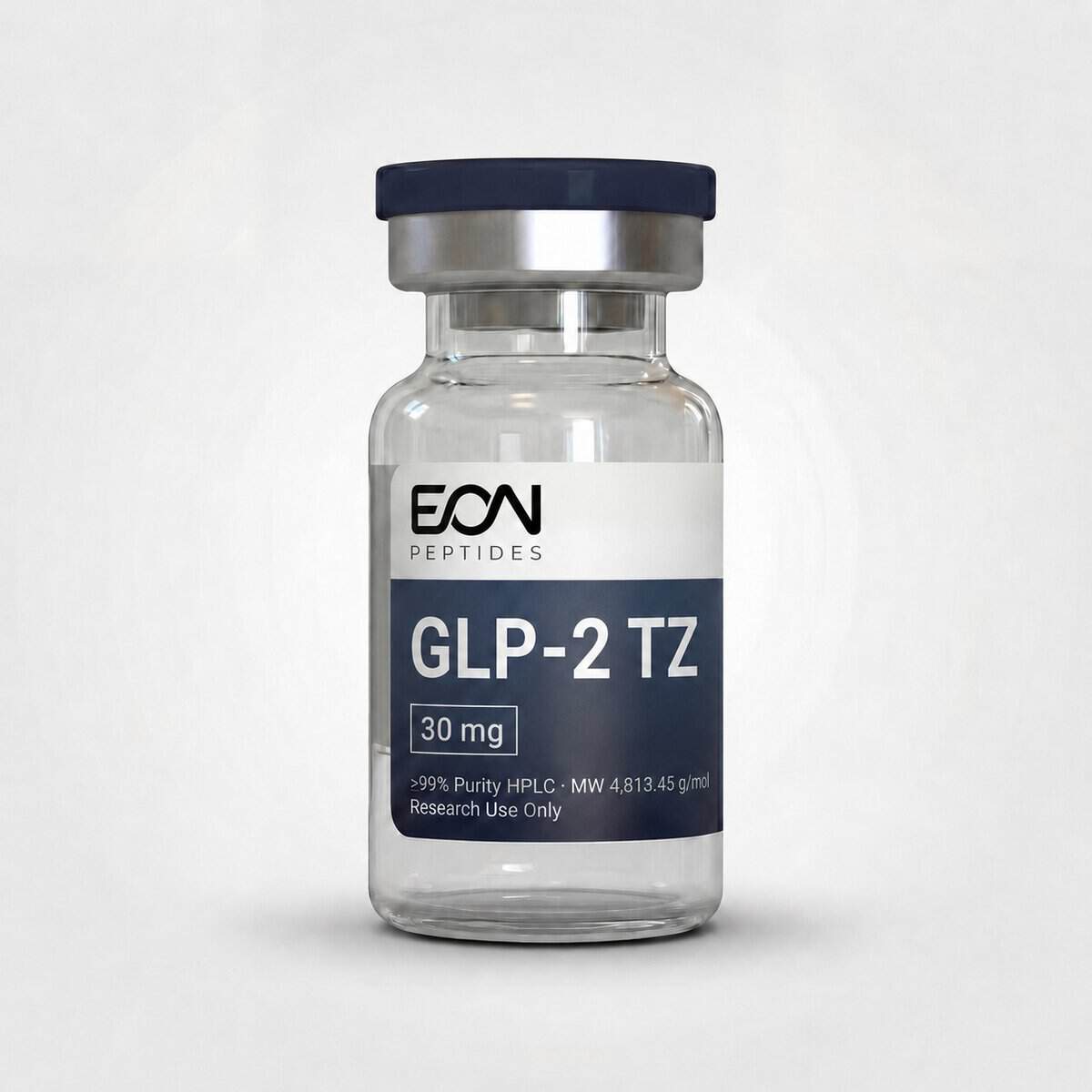
Molecular data
| Molecular formula | Available on request |
|---|---|
| Molecular weight | 3752 Da |
| Sequence | HADGSFSDEMNTILDNLAARDFINWLIQTKITD |
| Sequence length | 33 residues |
| Physical form | Lyophilized powder (5mg) |
| Available sizes | 10mg, 30mg, 60mg, 100mg |
How it works
-
GLP-2R Agonism
Glucagon-Like Peptide-2 Receptor Activation
GLP-2-TZ is a synthetic analog of glucagon-like peptide-2 (GLP-2), a 33-amino acid hormone secreted by enteroendocrine L-cells in the distal intestine. It binds and activates the GLP-2 receptor (GLP-2R), a G-protein coupled receptor expressed primarily on intestinal subepithelial myofibroblasts, enteric neurons, and intestinal epithelial cells. GLP-2R activation initiates trophic signaling cascades relevant to intestinal adaptation research.
- Selective GLP-2R agonist (Gs-coupled GPCR)
- Activates cAMP/PKA signaling in intestinal subepithelial cells
- Downstream IGF-1 and EGF receptor cross-talk measured
-
Mucosal Trophism
Intestinal Villus Growth & Crypt Expansion
GLP-2 signalling is studied against intestinal mucosal growth, with crypt cell proliferation and apoptosis in villus epithelial cells as the measured endpoints. In short bowel syndrome research models, villus height, crypt depth and total mucosal surface area were recorded - the parameter that determines absorptive capacity.
- Intestinal villus height and crypt depth measured
- Enterocyte apoptosis measured in mucosal injury models
- Intestinal mucosal surface area measured
-
DPP-IV Resistance
Extended Biological Half-Life
Native GLP-2 is rapidly degraded by dipeptidyl peptidase-IV (DPP-IV) cleaving at position 2, limiting its half-life to ~7 minutes. GLP-2-TZ incorporates structural modifications (analogous to teduglutide's Gly2→Ala2 substitution) that confer resistance to DPP-IV cleavage, extending the plasma half-life and enabling more sustained GLP-2R activation in preclinical and clinical contexts.
- Resistant to DPP-IV cleavage at N-terminus
- Extended plasma half-life vs. native GLP-2
- More sustained GLP-2R activation in research models
What the research shows
-
GI Research
Short Bowel Models
GLP-2 analogs structurally related to GLP-2-TZ are a primary research model for intestinal adaptation. Teduglutide is an approved pharmaceutical in this class; this research material is not.
-
Mucosal Biology
Intestinal Adaptation
GLP-2R activation is studied against intestinal adaptation endpoints including villus hyperplasia, nutrient transporter expression and mucosal blood flow - measured in resection and injury models.
-
Barrier Function
Intestinal Permeability
GLP-2 signalling has been studied in intestinal barrier function research, with paracellular permeability and tight junction integrity measured in injury models - endpoints also used in inflammatory bowel disease research.
-
IBD Research
Crohn's Disease Models
In rodent models of colitis and Crohn's disease, mucosal inflammation, barrier integrity and mucosal repair endpoints were measured following GLP-2 analog administration.
Specification
| Also Known As | GLP-2 Analog, [Gly2]GLP-2, Teduglutide-type GLP-2 |
|---|---|
| Type | Synthetic GLP-2 receptor agonist peptide |
| Length | 33 amino acids |
| Molecular Weight | ~3752 Da |
| Target Receptor | GLP-2 Receptor (GLP-2R, GPCR) |
| Mechanism | DPP-IV-resistant GLP-2R agonist; intestinal trophic signaling |
| Form | Lyophilized powder (5mg) |
| Purity | ≥99% (HPLC verified) |
| Testing | Third-party HPLC, Mass Spec, Endotoxin |
| Storage | -20°C for long-term stability |
| Solubility | Water-soluble |
| COA | Included with every order |
| Molecular Formula | Available on request |
| Appearance | White to off-white powder |
| Quantity | 5mg |
| Stability | 24 months from manufacture date when stored properly |
How it's tested
Every lot of GLP-2 TZ released to the catalog carries a third-party certificate of analysis. 7 documented lots are on file for this compound, with reported HPLC purity from 99.84% to 99.99% (mean 99.94%), issued by Accurate Test Labs and Freedom Diagnostics. 7 of 7 certificates record identity as confirmed.
- Documented lots
- 7
- Reported purity
- 99.84% to 99.99%
- Mean purity
- 99.94%
- Issuing labs
- Accurate Test Labs, Freedom Diagnostics
- 2026-09-03 Lot GLP2-TZ-090226-10Accurate Test Labs 99.94% View certificate
- 2026-09-03 Lot GLP2-TZ-090226-60Accurate Test Labs 99.96% View certificate
- 2026-09-03 Lot GLP2-TZ-090226-30Accurate Test Labs 99.95% View certificate
Frequently asked questions
What is GLP-2-TZ and how does it relate to clinically developed GLP-2 analogs?
GLP-2-TZ is a synthetic analog of glucagon-like peptide-2 (GLP-2), designed with structural modifications that confer resistance to DPP-IV degradation - the same design principle used in clinically developed GLP-2 analogs. Native GLP-2 has a ~7-minute plasma half-life due to rapid DPP-IV cleavage at position 2; DPP-IV-resistant analogs including GLP-2-TZ incorporate an Ala2 substitution (replacing Gly2 in native GLP-2) to resist this degradation. GLP-2-TZ is used as a research tool to study GLP-2R-mediated intestinal physiology.
What is the GLP-2 receptor and where is it expressed?
The GLP-2 receptor (GLP-2R) is a G-protein coupled receptor (GPCR) whose expression is highly restricted to the gastrointestinal tract. Primary expression sites include intestinal subepithelial myofibroblasts (ISEMFs), enteric neurons of the submucosal and myenteric plexus, and scattered enteroendocrine cells. This tissue specificity distinguishes GLP-2R from GLP-1R, which is expressed broadly (pancreas, heart, brain, kidney). The restricted expression pattern means GLP-2 analogs primarily affect intestinal physiology, which is central to their research relevance for intestinal adaptation and short bowel syndrome.
What is short bowel syndrome (SBS) and why is GLP-2 relevant?
Short bowel syndrome (SBS) results from surgical resection of large portions of the small intestine, leaving insufficient absorptive surface area to maintain nutrition without parenteral support. The intestine undergoes adaptation after resection - villus hyperplasia and crypt expansion - which GLP-2 signalling modulates. GLP-2 rises after intestinal resection, indicating a physiological role in that adaptation. Teduglutide, the approved GLP-2 analog, acts on this mechanism; that approval covers the licensed medicine only, not this research material.
What research models is GLP-2-TZ used in?
GLP-2-TZ is used in intestinal biology research models including: small bowel resection/intestinal adaptation models (rodents); intestinal organoid/enteroid culture systems for mucosal growth studies; intestinal permeability and barrier function assays; inflammatory bowel disease models (colitis, Crohn's); and in vitro GLP-2R binding and signaling studies. The compound is also used to investigate paracrine signaling between enteric neurons, ISEMFs, and epithelial cells in the intestinal niche.
How does GLP-2-TZ differ from an approved GLP-2 pharmaceutical?
An approved GLP-2 analog pharmaceutical exists for one clinical indication. GLP-2-TZ is not that compound and has not undergone independent clinical development. The research-grade GLP-2-TZ sold on eonpeptides.com is a research tool for studying GLP-2 receptor biology: it is for in vitro research purposes only and is not the approved pharmaceutical product.
How should GLP-2-TZ be stored?
Store lyophilized GLP-2-TZ at -20°C, protected from light, and minimize freeze-thaw cycles.
Related monographs
For laboratory research use only. Not a drug, supplement, or medical product; not for human or animal use. All findings referenced are from published preclinical/laboratory research.