
The molecule, in three dimensions
- Heavy atoms
- 217
- Bonds
- 216
- Composition
- C129 N33 O55
- Rings
- None
- Metal centre
- None
- Chain length
- 28 residues
Every heavy atom is placed from the sequence with ideal bond lengths and angles, so the connectivity is exact. The pose is idealised, an ideal helix, and is not a measured conformation. Identity for the lot in stock is confirmed by LC-MS on its certificate.
Molecular data
| Molecular formula | C129H215N33O55 |
|---|---|
| Molecular weight | 3108.29 Da |
| Sequence | SDAAVDTSSEITTKDLKEKKEVVEEAEN |
| Sequence length | 28 residues |
| CAS / identifier | 62304-98-7 |
| Physical form | Lyophilized Powder |
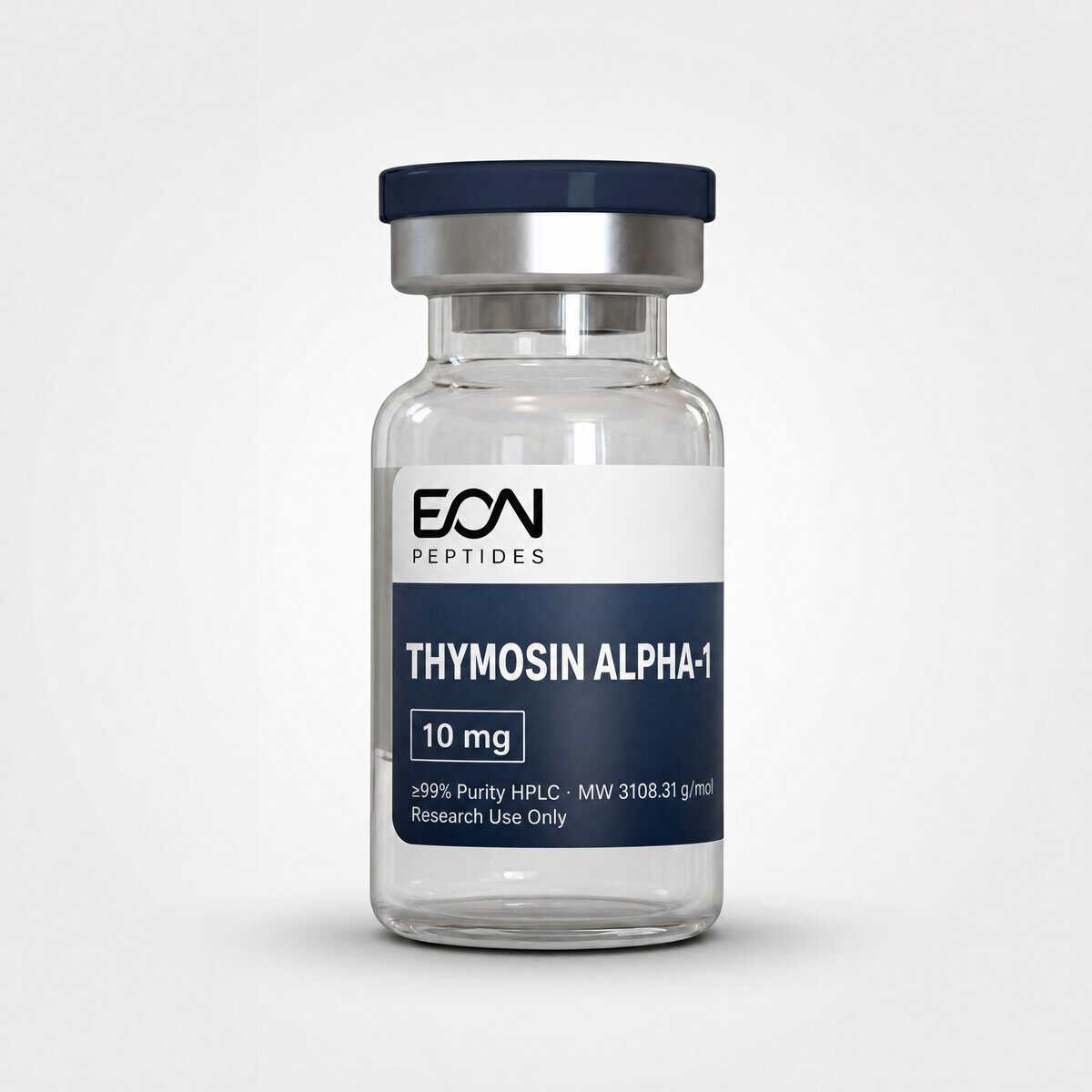
| Available sizes | 10mg |
How it works
-
T-Cell Maturation
Thymic Immune Modulation
T-lymphocyte maturation and differentiation, and the balance of T-cell subsets, are measured in preclinical immunology models following Thymosin Alpha-1.
- T-cell differentiation measured
- Modulates CD4+/CD8+ balance
- Lymphocyte counts measured in immunosuppressed models
-
TLR Signaling
Toll-Like Receptor Activation
Research indicates Tα1 signals through Toll-like receptors (notably TLR2 and TLR9) on dendritic cells and monocytes, influencing innate-immune activation and cytokine expression.
- Engages TLR2 / TLR9 pathways
- Dendritic-cell maturation
- Modulates cytokine profiles
-
Cytokine / NK
NK & Th1 Cytokine Modulation
In-vitro and animal studies report raised natural-killer-cell activity and a shift toward a Th1 cytokine profile (IFN-γ, IL-2) - endpoints used in antiviral and antitumour immune-response research.
- NK-cell activity measured
- Th1 cytokine shift (IFN-γ, IL-2)
- Studied in viral and tumour models
What the research shows
-
Immunology
T-Cell Research
Used to study thymic-dependent T-lymphocyte maturation and immune cell repopulation in immunosuppressed animal models.
-
Antiviral
Viral-Response Models
Investigated in hepatitis and other viral models for its influence on innate and adaptive antiviral immunity.
-
Oncology (preclinical)
Tumour-Immunity Models
Studied as an immune adjuvant in preclinical tumour models, with NK and cytotoxic T-cell responses as the measured endpoints.
-
Inflammation
Cytokine Regulation
Examined for modulation of inflammatory cytokine networks and dendritic-cell function in vitro.
Specification
| Strength | 10mg |
|---|---|
| molecular_formula | C129H215N33O55 |
| Molecular Weight | 3108.29 g/mol |
| Purity | >99% (HPLC) |
| Form | Lyophilized Powder |
| Lot Number | Assigned on shipment |
| Verified Purity | >99% |
| Quantity | 10mg |
| Molecular Formula | Available on request |
| Appearance | White to off-white powder |
| Analysis Date | Available on request |
| Stability | 24 months from manufacture date when stored properly |
| Storage | Store at -20°C, protected from light |
How it's tested
Every lot of Thymosin Alpha-1 released to the catalog carries a third-party certificate of analysis. 2 documented lots are on file for this compound, with reported HPLC purity from 99.65% to 99.87% (mean 99.76%), issued by Accurate Test Labs and Freedom Diagnostics. 2 of 2 certificates record identity as confirmed.
- Documented lots
- 2
- Reported purity
- 99.65% to 99.87%
- Mean purity
- 99.76%
- Issuing labs
- Accurate Test Labs, Freedom Diagnostics
- 2026-09-15 Lot TA1-091126-10Accurate Test Labs 99.87% View certificate
- 2026-04-14 Lot THYMA10-042026-1Freedom Diagnostics 99.65% View certificate
Frequently asked questions
What is Thymosin Alpha-1?
Thymosin Alpha-1 (Tα1) is an acetylated 28-amino-acid peptide originally isolated from thymic tissue (thymosin fraction 5). It is a well-characterized immunomodulator studied for its effects on T-cell maturation, Toll-like-receptor signaling, and innate/adaptive immune balance in cell-culture and animal models.
Is Thymosin Alpha-1 FDA approved?
No. Thymosin Alpha-1 is not approved by the FDA for any use in the United States. A synthetic form (thymalfasin) is approved as an immunomodulator in a number of other countries, but this product is supplied strictly as a reference compound for in-vitro laboratory research.
How should Thymosin Alpha-1 be stored?
Store the lyophilized powder at −20°C, protected from light; it is stable for approximately 24 months from manufacture. This is storage guidance for the researcher, not a shipping requirement.
What purity is this Thymosin Alpha-1?
Each lot is ≥99% pure by HPLC with identity confirmed by mass spectrometry and ships with third-party analytical documentation of purity, net peptide content, and endotoxin screening.
Related monographs
For laboratory research use only. Not a drug, supplement, or medical product; not for human or animal use. All findings referenced are from published preclinical/laboratory research.