
The molecule, in three dimensions
- Heavy atoms
- 347
- Bonds
- 350
- Composition
- C212 N56 O78 S1
- Rings
- 4
- Metal centre
- None
- Chain length
- 43 residues
Every heavy atom is placed from the sequence with ideal bond lengths and angles, so the connectivity is exact. The pose is idealised, an ideal helix, and is not a measured conformation. Identity for the lot in stock is confirmed by LC-MS on its certificate.
Molecular data
| Molecular formula | C212H350N56O78S |
|---|---|
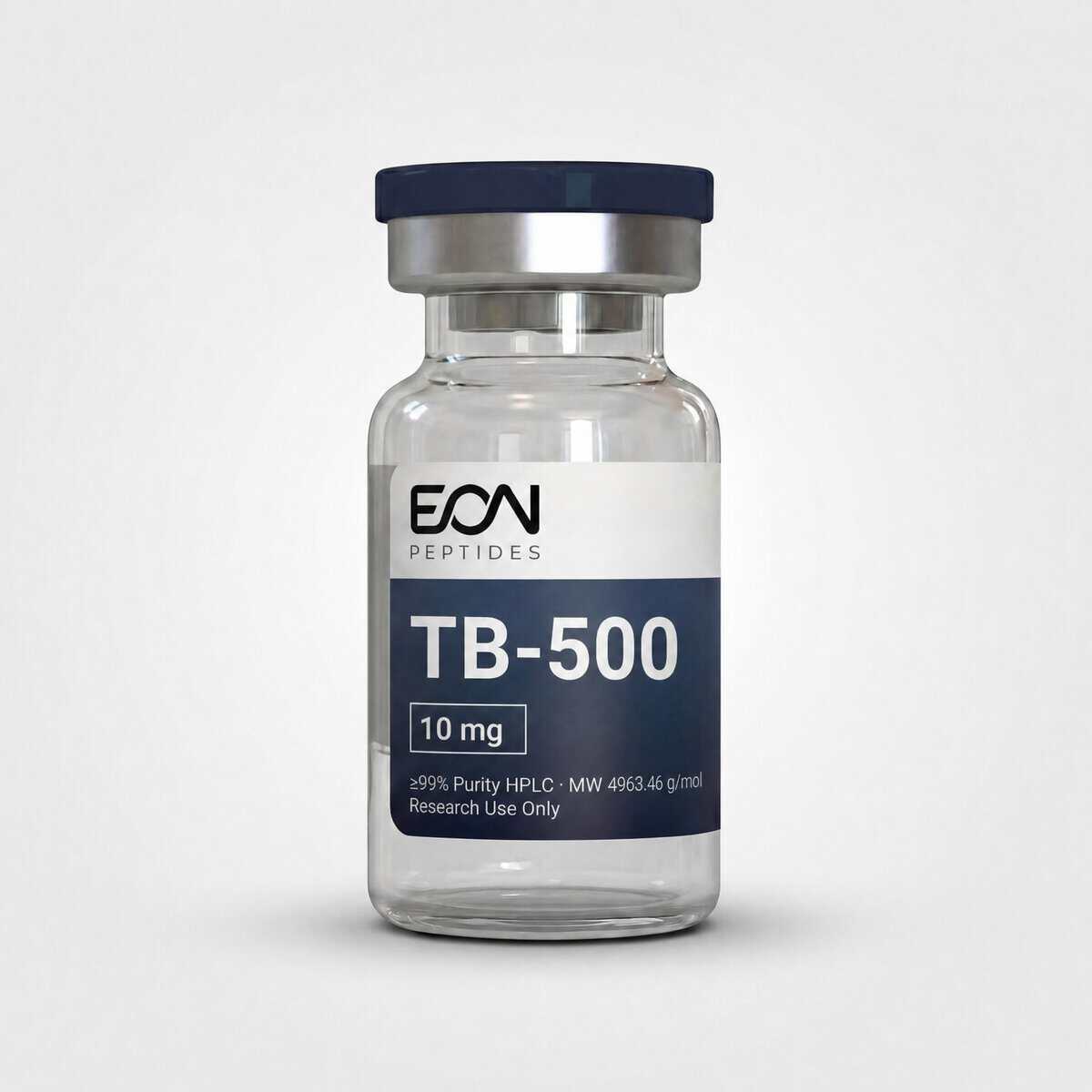
| Molecular weight | 4963.44 Da |
| Sequence length | 43 residues |
| Physical form | Lyophilized Powder |
| Available sizes | 10mg |
How it works
-
Actin Binding
Motility and Migration of Cells
The mechanism characterised most often is G-actin monomer binding by TB-500. Preclinical models then measure migration of cells toward injury sites and the polymerisation of actin.
- G-actin sequestering regulates polymerization
- Cells measured moving toward injury sites
- Cytoskeleton remodelling was observed
-
Cardiac Research
ILK Signalling in Cardiac Models
Cardiac studies of TB-500 examine cardiac progenitor cell migration and integrin-linked kinase (ILK) signalling.
- Integrin-linked kinase (ILK) is activated
- Cardiac progenitor migration is quantified
- Progenitor migration models in cardiac tissue
-
Cytokine Profile
Modulation of Inflammatory Signalling
Preclinical wound models record changed macrophage activity and reduced pro-inflammatory cytokines, the immune profile moving away from inflammatory markers toward those of the reparative phase.
- Measured reductions in pro-inflammatory cytokines
- Macrophage polarization is modulated
- Observed tissue remodelling of an anti-fibrotic character
What the research shows
-
Dermal Research
Models of Wound Closure
Preclinical wound models examine organized collagen deposition, scarring and closure of dermal wounds.
-
Cardiac Research
Heart Tissue Models
Post-infarction models examine migration of cardiac cells driven by ILK activation.
-
Ocular Research
Models of the Cornea
Ocular surface models examine inflammation and the closure of corneal epithelial wounds.
-
Soft Tissue
Muscle and Tendon Models
Ligament, tendon and muscle models examine fibrotic scoring and cell migration mediated by actin.
How it's tested
Every lot of TB-500 released to the catalog carries a third-party certificate of analysis. 5 documented lots are on file for this compound, with reported HPLC purity from 99.17% to 99.86% (mean 99.52%), issued by Accurate Test Labs and Freedom Diagnostics. 4 of 5 certificates record identity as confirmed.
- Documented lots
- 5
- Reported purity
- 99.17% to 99.86%
- Mean purity
- 99.52%
- Issuing labs
- Accurate Test Labs, Freedom Diagnostics
- 2026-09-03 Lot TB5-090226-10Accurate Test Labs 99.26% View certificate
- 2026-08-19 Lot Auth2608120794Freedom Diagnostics 99.17% View certificate
- 2026-05-27 Lot Auth2605270305Freedom Diagnostics 99.58% View certificate
Frequently asked questions
How is TB-500 classified and what is its structure?
TB-500 is a synthetic peptide matching Thymosin Beta-4 (Tβ4) across its active region. Tβ4 is a protein of 43 amino acids occurring naturally in every nucleated cell. Through interaction with the actin cytoskeleton, Tβ4 is investigated for roles in tissue remodelling, differentiation and cell migration.
What distinguishes TB-500 structurally from full-length Thymosin Beta-4?
Tβ4 is the entire sequence of 43 amino acids, whereas TB-500 carries its active fragment, the region that accounts for cell migration properties and actin binding. The core mechanism of action is the same for both.
What regulatory standing does TB-500 hold?
Neither the FDA nor any other regulatory agency has approved TB-500 for human use. As a thymosin beta-4 fragment it is provided solely for laboratory research in vitro, and for the material supplied here a human safety profile has not been established.
Which research fields make use of TB-500?
Preclinical models of inflammatory signalling, tendon and muscle, the corneal surface, cardiac tissue and wound closure all feature TB-500. One primary mechanism runs through every one of these fields: actin regulation leading to cell migration.
What storage conditions preserve lyophilized TB-500?
Long-term stability of lyophilized TB-500 calls for -20°C. Light exposure and repeated freeze-thaw cycling are to be avoided.
Does TB-500 correspond to a pharmaceutical thymosin beta-4 formulation?
No. Regulatory approval has not been granted to TB-500, and the FDA has not approved it for any indication. The material supplied here differs from the pharmaceutical formulation of thymosin beta-4 and is offered solely for laboratory research in vitro.
Selected preclinical literature
8 published studies on TB-500, limited by rule to animal models and cell-based (in vitro) work indexed in PubMed. Human trials, case reports and literature overviews are excluded. Titles appear as published and each links to its PubMed record; the list was resolved against PubMed on 2026-10-12. A listing describes what a study examined, not a property of the material supplied.
-
Mice model and in vitro
Decidualization-empowered ECM hydrogel integrating sustained Tβ4 release drives endometrial regeneration in intrauterine adhesions
Nature communications, 2026. PubMed PMID 41565687 · doi:10.1038/s41467-026-68677-w
-
Mice model and in vitro
Plasmacytoid dendritic cells alleviate allergic asthma via airway epithelial cell-dependent thymosin β4 expression
The Journal of allergy and clinical immunology, 2025. PubMed PMID 39978686 · doi:10.1016/j.jaci.2025.01.047
-
Rats model
Tβ4-Engineered ADSC Extracellular Vesicles Rescue Cell Senescence Through Separable Microneedle Patches for Diabetic Wound Healing
Advanced science (Weinheim, Baden-Wurttemberg, Germany), 2025. PubMed PMID 40279568 · doi:10.1002/advs.202505009
-
Mice model and in vitro
Protection effect of thymosin β4 on ethanol injury in corneal stromal keratocyte
BMC ophthalmology, 2022. PubMed PMID 35062902 · doi:10.1186/s12886-022-02255-8
-
Chickens model and in vitro
Thymosin β4 dynamics during chicken enteroid development
Molecular and cellular biochemistry, 2021. PubMed PMID 33301106 · doi:10.1007/s11010-020-04008-x
-
Mice model and in vitro
Thymosin β4 released from functionalized self-assembling peptide activates epicardium and enhances repair of infarcted myocardium
Theranostics, 2021. PubMed PMID 33754060 · doi:10.7150/thno.52309
-
Mice model and in vitro
Thymosin β4 reverses phenotypic polarization of glial cells and cognitive impairment via negative regulation of NF-κB signaling axis in APP/PS1 mice
Journal of neuroinflammation, 2021. PubMed PMID 34183019 · doi:10.1186/s12974-021-02166-3
-
Mice model and in vitro
Thymosin β4 protects against aortic aneurysm via endocytic regulation of growth factor signaling
The Journal of clinical investigation, 2021. PubMed PMID 33784254 · doi:10.1172/JCI127884
Related monographs
For laboratory research use only. Not a drug, supplement, or medical product; not for human or animal use. All findings referenced are from published preclinical/laboratory research.