
The molecule, in three dimensions
- Heavy atoms
- 57
- Bonds
- 60
- Composition
- C37 N9 O10 S1
- Rings
- 4
- Metal centre
- None
- Chain length
- 7 residues
Every heavy atom is placed from the sequence with ideal bond lengths and angles, so the connectivity is exact. The pose is idealised, an extended chain, and is not a measured conformation. Identity for the lot in stock is confirmed by LC-MS on its certificate.
Molecular data
| Molecular formula | C37H51N9O10S |
|---|---|
| Molecular weight | 813.93 Da |
| Sequence | Met-Glu-His-Phe-Pro-Gly-Pro |
| Sequence length | 7 residues |
| Physical form | Lyophilized Powder |
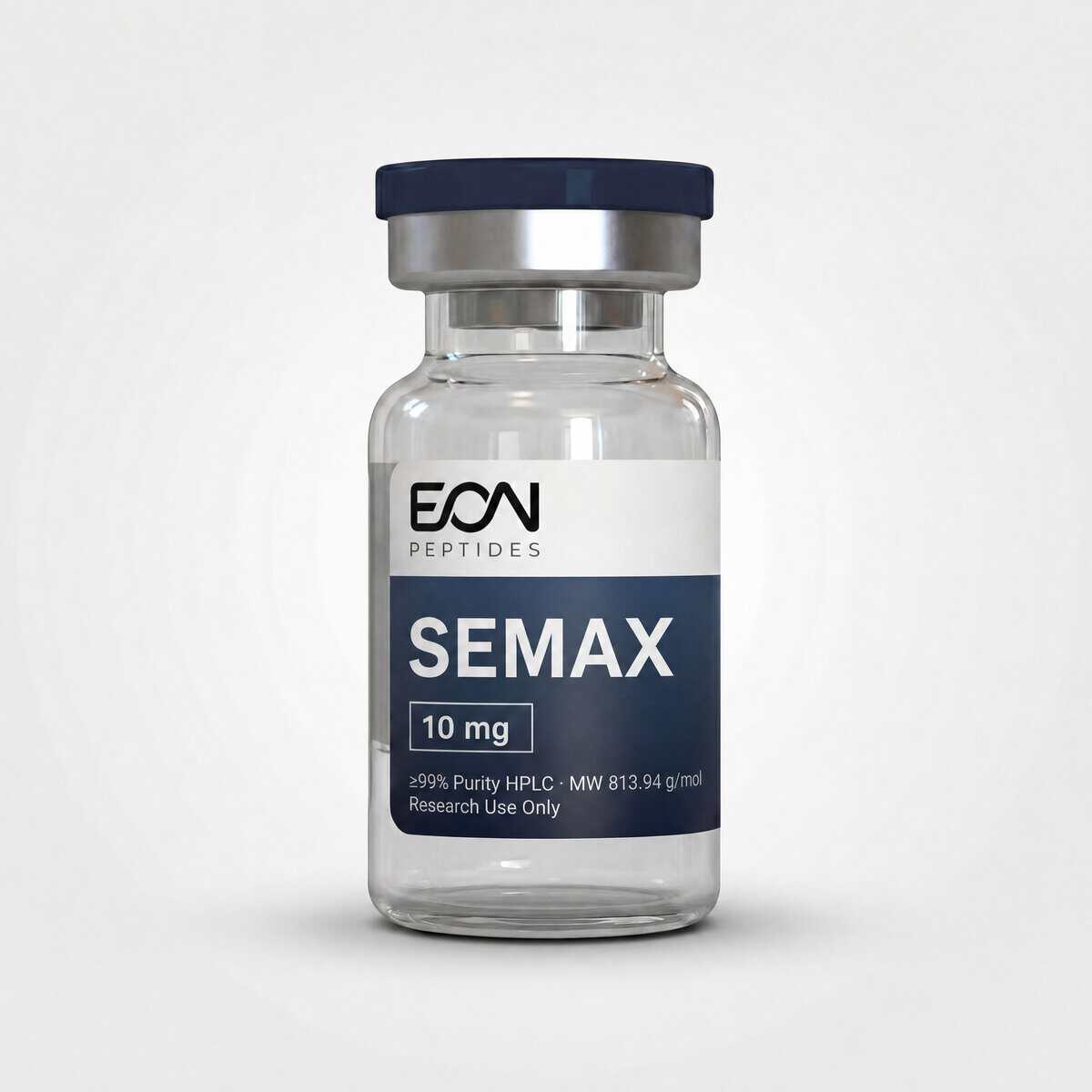
| Available sizes | 10mg |
How it works
-
Neurotrophic
BDNF Modulation
Brain-derived neurotrophic factor (BDNF) levels up to 1.4-fold baseline have been measured in specific brain regions, alongside neuronal survival and synaptic plasticity endpoints.
- BDNF expression up to 1.4× measured
- Neuronal survival and growth measured
- Synaptic plasticity measured
-
Neurotransmitter
Serotonin & Dopamine Modulation
Research demonstrates Semax modulates serotonergic and dopaminergic systems, influencing mood regulation, attention, and cognitive processing in preclinical models.
- Modulates serotonin metabolism
- Influences dopaminergic signaling
- Affects noradrenergic pathways
-
Neuroprotective
Ischemic Models
In ischemic stroke models, infarct volume, inflammatory gene expression and neuronal survival under oxygen deprivation are the recorded endpoints.
- Infarct volume measured in stroke models
- Anti-inflammatory gene modulation
- Neuronal oxidative stress markers measured
What the research shows
-
Cognitive
Memory & Learning
Cognitive function, memory consolidation and attention measures are recorded in animal models. The Russian pharmaceutical formulation has been approved there as a nootropic since 2011.
-
Neuroprotection
Cerebral Ischemia Models
Infarct volume and neuronal survival are measured in cerebral ischemia models. The Russian pharmaceutical formulation is used clinically there; that use does not extend to this research material.
-
Neurotrophic
BDNF & Neurotrophin Signalling
Neurotrophin and receptor expression are measured, alongside neuronal plasticity endpoints.
-
Anti-Inflammatory
Immune Modulation
Lower pro-inflammatory cytokines and altered oxidative stress-related gene expression are measured in hippocampal tissue.
Specification
| Strength | 10mg |
|---|---|
| Molecular Formula | C37H51N9O10S |
| Molecular Weight | 813.93 g/mol |
| Purity | >99% (HPLC) |
| Form | Lyophilized Powder |
| Sequence | Met-Glu-His-Phe-Pro-Gly-Pro |
| Origin | Synthetic analog of ACTH(4-10) |
| Testing | Third-party HPLC, Mass Spec, Endotoxin |
| Storage | -20°C for up to 24 months |
| Solubility | Water-soluble |
| COA | Included with every order |
| Appearance | White to off-white powder |
How it's tested
Every lot of Semax released to the catalog carries a third-party certificate of analysis. 4 documented lots are on file for this compound, with reported HPLC purity from 99.08% to 99.99% (mean 99.52%), issued by Accurate Test Labs and Freedom Diagnostics. 4 of 4 certificates record identity as confirmed.
- Documented lots
- 4
- Reported purity
- 99.08% to 99.99%
- Mean purity
- 99.52%
- Issuing labs
- Accurate Test Labs, Freedom Diagnostics
- 2026-09-03 Lot SEM-090226-10Accurate Test Labs 99.99% View certificate
- 2026-07-24 Lot HKUDQ4Accurate Test Labs 99.08% View certificate
- 2026-04-22 Lot Auth2604200519Freedom Diagnostics 99.90% View certificate
Frequently asked questions
What is Semax and where does it come from?
Semax (Met-Glu-His-Phe-Pro-Gly-Pro) is a synthetic heptapeptide derived from the first four amino acids of adrenocorticotropic hormone (ACTH 4-10). It was developed at the Institute of Molecular Genetics of the Russian Academy of Sciences in the 1980s and has been approved in Russia as a prescription nootropic since 2011.
What has research shown about Semax?
Reported measures include BDNF levels up to 1.4-fold baseline, changes in serotonergic and dopaminergic systems, neuroprotective endpoints in ischemic stroke models, cognitive and memory measures in animal studies, and anti-inflammatory markers.
Is Semax FDA approved?
Semax is not approved by the FDA for any medical use in the United States. It is approved in Russia as a prescription medication for cognitive disorders and stroke recovery. In the US, it is available only as a research peptide for in vitro laboratory use.
How does Semax differ from N-Acetyl Semax?
N-Acetyl Semax (NASA) has an acetyl group added to the N-terminus, which raises stability and resistance to enzymatic degradation. Half-life is correspondingly longer than standard Semax.
How should Semax be stored?
Lyophilized Semax should be stored at -20°C for long-term stability (up to 24 months). Protect from heat and direct light.
Selected preclinical literature
8 published studies on Semax, limited by rule to animal models and cell-based (in vitro) work indexed in PubMed. Human trials, case reports and literature overviews are excluded. Titles appear as published and each links to its PubMed record; the list was resolved against PubMed on 2026-10-12. A listing describes what a study examined, not a property of the material supplied.
-
Rats model and in vitro
The Effect of Peptide Semax, an ACTH(4-10) Analogue, on Intracellular Calcium Dynamics in Rat Brain Neurons
Bulletin of experimental biology and medicine, 2025. PubMed PMID 41171324 · doi:10.1007/s10517-025-06501-z
-
Rats and Mice model and in vitro
Semax peptide targets the μ opioid receptor gene Oprm1 to promote deubiquitination and functional recovery after spinal cord injury in female mice
British journal of pharmacology, 2025. PubMed PMID 40692165 · doi:10.1111/bph.70122
-
Rats model
Antidepressant-like and antistress effects of the ACTH(4-10) synthetic analogs Semax and Melanotan II on male rats in a model of chronic unpredictable stress
European journal of pharmacology, 2024. PubMed PMID 39442746 · doi:10.1016/j.ejphar.2024.177068
-
Rats model
Semax, synthetic ACTH(4-10) analogue, attenuates behavioural and neurochemical alterations following early-life fluvoxamine exposure in white rats
Neuropeptides, 2021. PubMed PMID 33418449 · doi:10.1016/j.npep.2020.102114
-
Rats model
Morphofunctional State of the Large Intestine in Rats under Conditions of Restraint Stress and Administration of Peptide ACTH(4-7)-PGP (Semax)
Bulletin of experimental biology and medicine, 2021. PubMed PMID 33459919 · doi:10.1007/s10517-021-05072-z
-
Rats model
Brain Protein Expression Profile Confirms the Protective Effect of the ACTH(4-7)PGP Peptide (Semax) in a Rat Model of Cerebral Ischemia-Reperfusion
International journal of molecular sciences, 2021. PubMed PMID 34201112 · doi:10.3390/ijms22126179
-
Rats model
Composition of Colon Microbiota in Rats Treated with ACTH(4-7)-PGP Peptide (Semax) under Conditions of Restraint Stress
Bulletin of experimental biology and medicine, 2020. PubMed PMID 32737723 · doi:10.1007/s10517-020-04886-7
-
Rats model and in vitro
Modulation of GABA- and Glycine-Activated Ionic Currents with Semax in Isolated Cerebral Neurons
Bulletin of experimental biology and medicine, 2018. PubMed PMID 29577196 · doi:10.1007/s10517-018-4043-8
Related monographs
For laboratory research use only. Not a drug, supplement, or medical product; not for human or animal use. All findings referenced are from published preclinical/laboratory research.