
The molecule, in three dimensions
- Heavy atoms
- 29
- Bonds
- 28
- Composition
- C15 N6 O8
- Rings
- None
- Metal centre
- None
- Chain length
- 3 residues
Every heavy atom is placed from the sequence with ideal bond lengths and angles, so the connectivity is exact. The pose is idealised, an extended chain, and is not a measured conformation. Identity for the lot in stock is confirmed by LC-MS on its certificate.
Molecular data
| Molecular formula | C15H26N6O8 |
|---|---|
| Molecular weight | 418.4 Da |
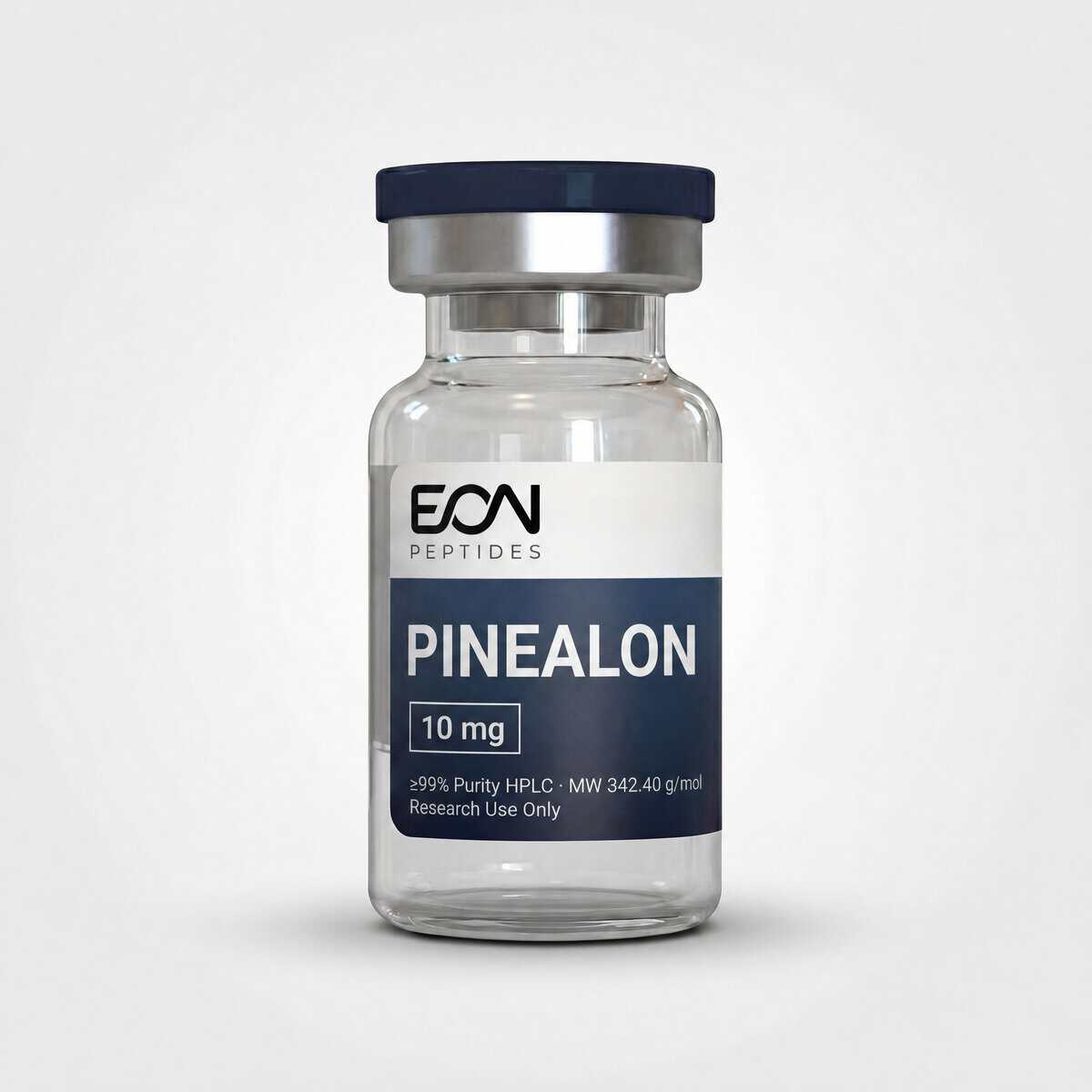
| Sequence | Glu-Asp-Arg |
| Sequence length | 3 residues |
| Physical form | Lyophilized powder |
| Available sizes | 10mg |
How it works
-
DNA-Level Regulation
Transcriptional Bioregulation
Structurally, pinealon is a tripeptide (Glu-Asp-Arg) that carries a net positive charge. Work from the Khavinson group frames peptides of this size as approaching chromatin and the promoter regions of particular genes by electrostatic attraction, and in doing so shifting the transcription of antioxidant and neuroprotective proteins.
- Promoter regions of particular genes are the proposed binding sites
- Changes in gene expression are described as sequence-specific
- Framed as regulation at the epigenetic level, not agonism at a receptor
-
Oxidative Load
Reactive Oxygen Species Restriction
Cell-culture experiments record a concentration-dependent limit on the build-up of reactive oxygen species (ROS) when neutrophils, PC12 cells and cerebellar granule cells are held under oxidative stress; necrotic death in the same cultures is reported to fall.
- ROS build-up in neuronal models held down as concentration rises
- Fewer necrotic cells where oxidative stress was applied
- Cerebellar granule and PC12 lines supplied the test systems
-
Trophic Factors
Neuronal Resistance and Plasticity
Prenatal preparations and aged animals have both served to profile how pinealon behaves where neurons are stressed. Reports note cerebellar neurons withstanding oxidative insult better, together with shifts in neurotrophic-factor expression.
- Prenatal hyperhomocysteinemia and hypoxia served as the study models
- Neurons reported to tolerate oxidative stress more readily
- Examined within research on cognition and aging
What the research shows
-
NEURAL MODELS
Oxidative Stress in Neurons
Where neuronal cultures were exposed to oxidative stress, published in vitro reports record ROS build-up held down as concentration rose, alongside fewer necrotic cells.
-
PRENATAL MODELS
Offspring Neuronal Studies
Rodent experiments placed pinealon in a prenatal hyperhomocysteinemia setting, describing altered cognitive measures in the offspring and cerebellar neurons that better withstood oxidative stress.
-
GENE REGULATION
Short Peptides and Transcription
EDR-class peptides appear in literature on short peptides that regulate gene expression and protein synthesis, with binding to specific DNA promoter regions put forward.
-
HYPOXIA WORK
Neuron Survival Without Oxygen
In vivo work on regulatory peptides, pinealon among them, tracked brain-neuron survival where oxygen supply was restricted.
How it's tested
Every lot of Pinealon released to the catalog carries a third-party certificate of analysis. 1 documented lot is on file for this compound, with reported HPLC purity from 99.84% to 99.84% (mean 99.84%), issued by Freedom Diagnostics. 1 of 1 certificates record identity as confirmed.
- Documented lots
- 1
- Reported purity
- 99.84% to 99.84%
- Mean purity
- 99.84%
- Issuing labs
- Freedom Diagnostics
- 2025-09-25 Lot PINE09222025-JFreedom Diagnostics 99.843% View certificate
Frequently asked questions
How is pinealon classified and what is its structure?
It is a synthetic tripeptide, its three residues being L-glutamic acid, then L-aspartic acid, then L-arginine: Glu-Asp-Arg, abbreviated EDR. Classification places it with the short-peptide bioregulators that came out of the program Professor Vladimir Khavinson ran at the St. Petersburg Institute of Bioregulation and Gerontology, where proposed activity on gene expression and neuroprotection is the subject of study.
What mechanism has been put forward for its activity inside cells?
Being short and positively charged, the peptide is hypothesised to reach chromatin and the promoter regions of particular genes through electrostatic interaction, and from there to shift transcription of neuroprotective and antioxidant proteins. Accounts describe this as an epigenetic-level mode of action, unlike compounds that work through neurotransmitters or receptors. The hypothesis is still under investigation.
Which oxidative-stress findings appear in the published record?
In vitro reports describe reactive oxygen species (ROS) accumulating less as concentration rises, in PC12 cells, in neutrophils and in cerebellar granule cells placed under oxidative stress. The same models are reported to show less necrotic cell death and better cell viability.
What is its regulatory status?
No regulatory authority, the FDA included, has authorised pinealon for therapeutic use in people. The literature that exists is preclinical and in vitro. Material of research grade sold here is limited to laboratory work in vitro, with no human and no veterinary use.
Where does it sit among the other Khavinson bioregulators such as Epitalon?
Both compounds are short-peptide bioregulators examined by the same research group, and both are described through the proposed peptide-DNA interaction framework. What separates them is the amino-acid sequence, and with it the gene targets and the research models each is linked to. For the EDR tripeptide, neuroprotection and oxidative stress dominate the published work.
What conditions preserve the lyophilized material?
Long-term stability of the lyophilized powder is described at minus 20 degrees Celsius, with light and moisture kept out so the peptide stays intact.
Related monographs
For laboratory research use only. Not a drug, supplement, or medical product; not for human or animal use. All findings referenced are from published preclinical/laboratory research.