
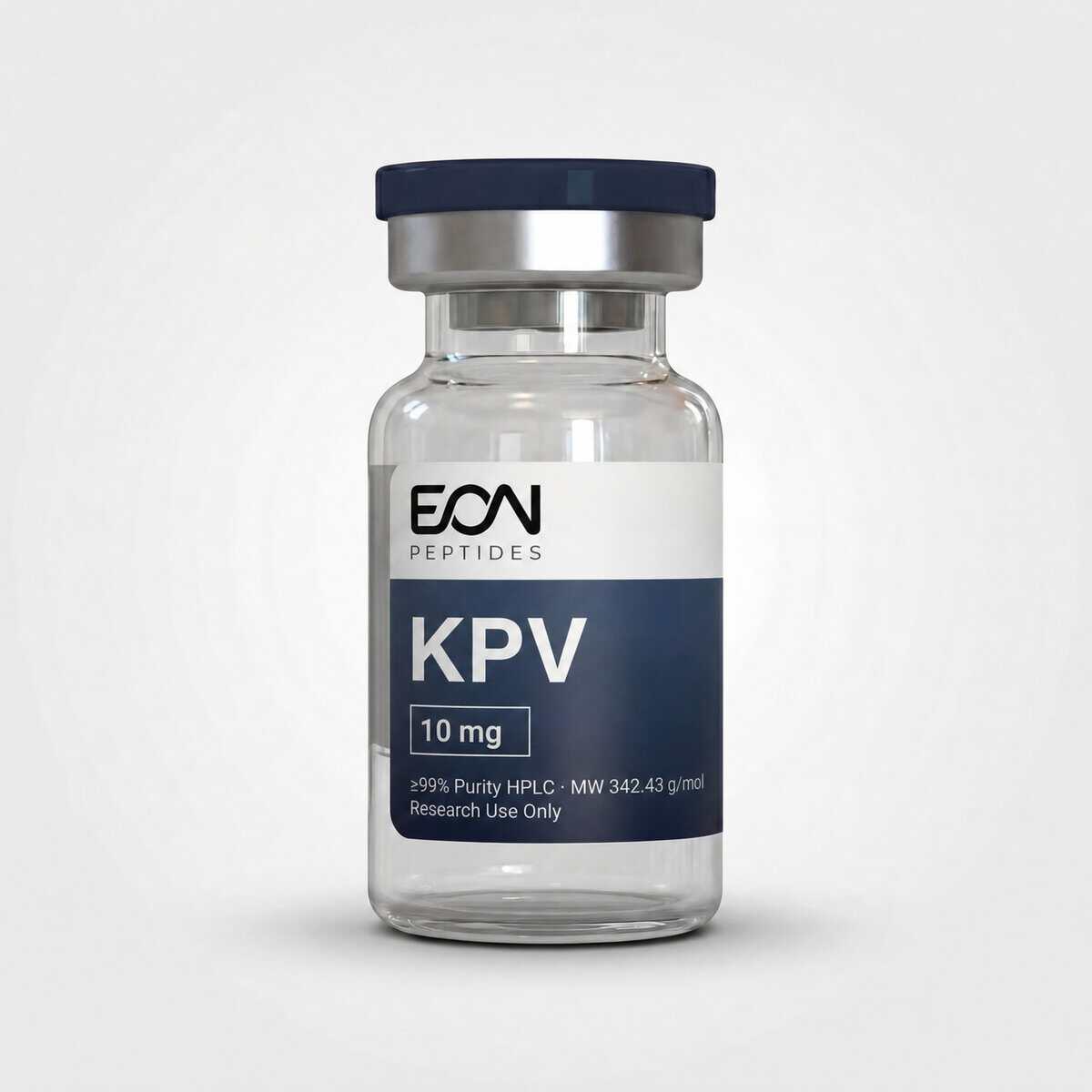
The molecule, in three dimensions
- Heavy atoms
- 24
- Bonds
- 24
- Composition
- C16 N4 O4
- Rings
- 1
- Metal centre
- None
- Chain length
- 3 residues
Every heavy atom is placed from the sequence with ideal bond lengths and angles, so the connectivity is exact. The pose is idealised, an extended chain, and is not a measured conformation. Identity for the lot in stock is confirmed by LC-MS on its certificate.
Molecular data
| Molecular formula | C16H31N5O4 |
|---|---|
| Molecular weight | 342.43 Da |
| Sequence | Lys-Pro-Val |
| Sequence length | 3 residues |
| Physical form | Lyophilized powder |
| Available sizes | 10mg |
How it works
-
Cytokine Signaling
Down-Regulated Inflammatory Cascade
In vitro measurement at nanomolar concentrations shows the NF-κB and MAP-kinase pathways activating less. Since NF-κB governs much of the transcription behind inflammation, the same experiments record less TNF-α, IL-6 and IL-1β being released.
- NF-κB and MAP-kinase signaling suppressed within the nanomolar range
- Release of TNF-α, IL-6, IL-1β and further pro-inflammatory cytokines measured lower
- The pro-inflammatory output is what shifts; anti-inflammatory cytokines are not the target
-
Transporter Entry
PepT1 Route Into the Cell
Published work has the tripeptide entering cells through PepT1, a carrier for di- and tripeptides found on immune cells and on intestinal epithelium. That route puts the peptide inside the cell, where inflammatory signaling can be engaged directly.
- Cell entry occurs by way of the PepT1 peptide carrier
- That carrier is present on immune cells and intestinal epithelium
- Intracellular access to inflammatory pathways follows from it
-
Melanocortin Origin
Fragment of α-MSH
Positioned at the C-terminus of alpha-melanocyte-stimulating hormone, the sequence corresponds to α-MSH 11-13. Reports assign the greater part of the parent hormone's anti-inflammatory activity to this fragment, which in vitro also shows antimicrobial activity.
- Occupies the C-terminal position within the melanocortin peptide α-MSH
- Holds the greater part of the parent hormone's anti-inflammatory activity
- Reported active against S. aureus and against C. albicans
What the research shows
-
GUT MODELS
Colitis Model Findings
Colitis induced with DSS and with TNBS gave lower intestinal inflammation scores once PepT1 had carried the tripeptide into cells.
-
IMMUNE SIGNALING
Carrier of Melanocortin Activity
The literature treats this C-terminal tripeptide as the segment holding most of the anti-inflammatory and immunomodulating activity attributed to α-MSH.
-
OCULAR SURFACE
Corneal Re-Epithelialization
Applied to the rabbit cornea surface, the peptide was followed by re-epithelialization complete within 60 hours; nitric-oxide signaling is raised as a possible route.
-
MICROBIAL ASSAYS
Activity Against Bacteria and Yeast
Across a wide span of concentrations, published assays describe activity against Staphylococcus aureus and against Candida albicans.
How it's tested
Every lot of KPV released to the catalog carries a third-party certificate of analysis. 2 documented lots are on file for this compound, with reported HPLC purity from 99.27% to 99.75% (mean 99.51%), issued by Freedom Diagnostics. 1 of 2 certificates record identity as confirmed.
- Documented lots
- 2
- Reported purity
- 99.27% to 99.75%
- Mean purity
- 99.51%
- Issuing labs
- Freedom Diagnostics
- 2025-12-24 Lot KPV12222025-JFreedom Diagnostics 99.269% View certificate
- 2025-12-17 Lot KPV1012102025-08Freedom Diagnostics 99.753% View certificate
Frequently asked questions
How is KPV classified and what is its structure?
It is a tripeptide of lysine, proline and valine. By position it ends alpha-melanocyte-stimulating hormone, that is α-MSH 11-13, and the parent hormone's anti-inflammatory and immunomodulating activity is largely assigned to this fragment.
Which signaling pathways respond to it in inflammation research?
Nanomolar concentrations are reported to inhibit both the NF-κB and the MAP-kinase inflammatory pathways. NF-κB sits above much of the transcription driving inflammation, so holding it back lowers research-model output of cytokines on the pro-inflammatory side: IL-1β, IL-6, TNF-α.
What role does the PepT1 transporter play in the mechanism?
PepT1 carries di- and tripeptides across the membrane and is found on immune cells and on intestinal epithelial cells. Research has the tripeptide entering by that carrier, reaching inflammatory signaling inside the cell; the route is regarded as central in models of intestinal inflammation.
What was recorded in induced colitis experiments?
Mouse colitis induced with DSS and with TNBS gave lower intestinal inflammation scores where PepT1 had taken the peptide up, and pro-inflammatory cytokine expression fell: IFN-γ, TNF-α, IL-12, IL-6 and IL-1β.
How far does the research record extend beyond preclinical work?
It does not. Clinical trials in people have not been completed, although preclinical study across several organ systems now spans roughly two decades. Material of research grade sold here is limited to laboratory work in vitro, with no human and no veterinary use.
What conditions preserve the lyophilized material?
The lyophilized powder is described as keeping at minus 20 degrees Celsius, with light and moisture excluded so the peptide stays intact.
Related monographs
For laboratory research use only. Not a drug, supplement, or medical product; not for human or animal use. All findings referenced are from published preclinical/laboratory research.