
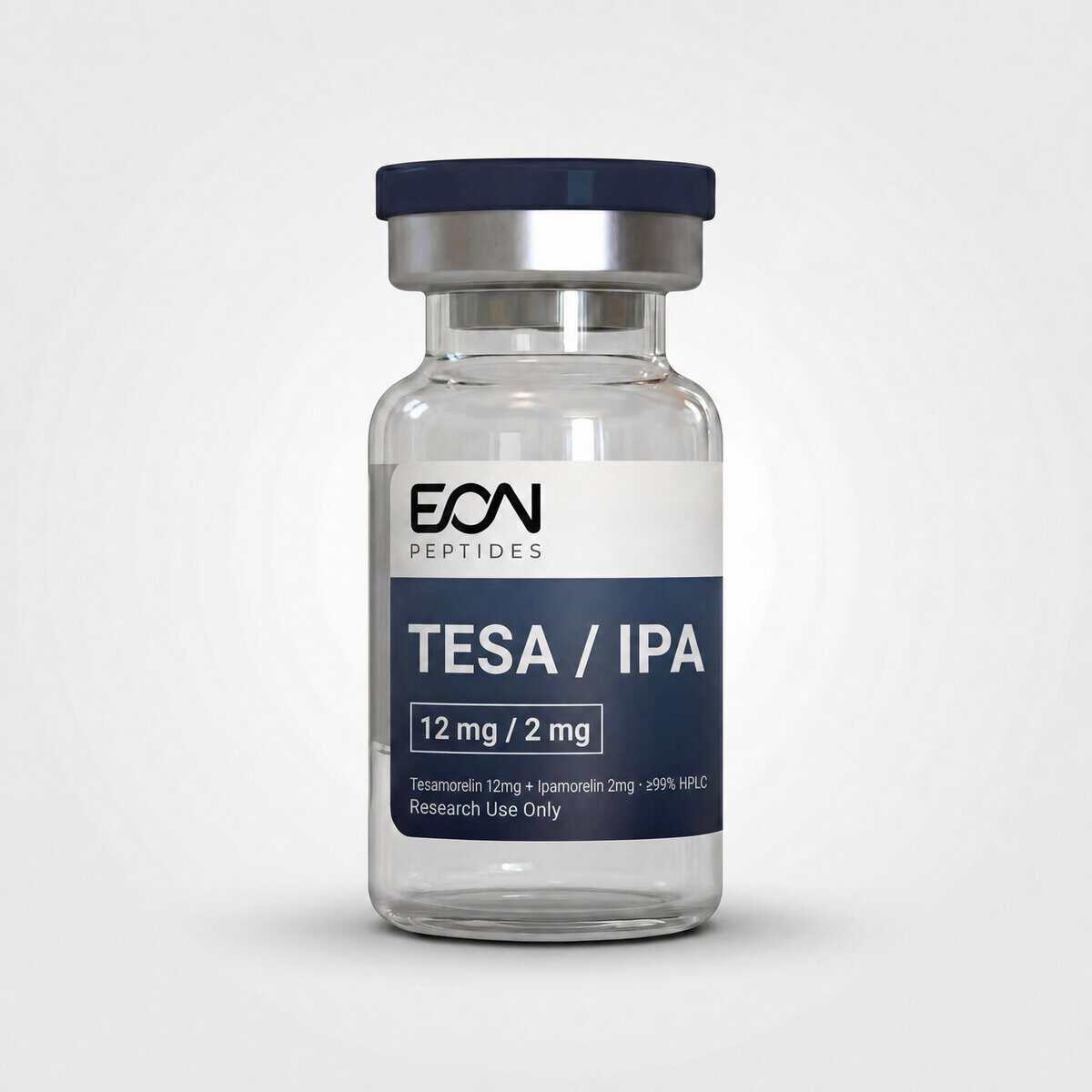
Molecular data
| Molecular formula | Tesamorelin: C221H366N72O67S; Ipamorelin: C38H49N9O5 |
|---|---|
| Molecular weight | 5135.8 Da |
| Sequence | Tesamorelin: Tyr-Ala-Asp-Ala-Ile-Phe-Thr-Asn-Ser-Tyr-Arg-Lys-Val-Leu-Gly-Gln-Leu-Ser-Ala-Arg-Lys-Leu-Leu-Gln-Asp-Ile-Met-Ser-Arg-Gln-Gln-Gly-Glu-Ser-Asn-Gln-Glu-Arg-Gly-Ala-Arg-Ala-Arg-Leu (trans-3-hexenoyl modified at N-terminus); Ipamorelin: Aib-His-D-2-Nal-D-Phe-Lys-NH2 |
| Sequence length | 44 residues |
| CAS / identifier | Tesamorelin CAS 218949-48-5; Ipamorelin CAS 170851-70-4 |
| Physical form | Lyophilized powder |
| Available sizes | 15mg |
How it works
-
Tesamorelin Component
GHRH Receptor Agonism
Tesamorelin is a synthetic, stabilized analog of human GHRH(1-44). It binds and activates pituitary GHRH receptors, with endogenous growth-hormone secretion measured while the pulsatile release pattern is preserved - unlike exogenous GH administration.
- Selective GHRH-receptor agonism at the pituitary
- Preserves physiological pulsatile GH secretion
- Downstream IGF-1 production measured
-
Ipamorelin Component
Selective GHS-R Agonism
Ipamorelin is a pentapeptide growth-hormone secretagogue that acts on the ghrelin receptor (GHS-R1a). It is the first highly selective GHS - GH release is measured without accompanying rises in ACTH, cortisol or prolactin.
- Acts on the ghrelin receptor (GHS-R1a), a GHRP-like pathway
- Highly selective for GH release among secretagogues
- Minimal effect on cortisol, prolactin, ACTH in research models
-
Dual-Pathway Design
Dual-Receptor GH Axis
Pairing a GHRH analog with a ghrelin-receptor secretagogue engages two distinct pituitary pathways. Research into GHRH + GHRP combinations examines whether the two mechanisms act in a complementary fashion on growth-hormone release.
- Targets GHRH-R and GHS-R simultaneously
- Studied as a complementary, two-pathway research model
- Both components act on endogenous GH secretion, not exogenous GH
What the research shows
-
ENDOCRINOLOGY
GH / IGF-1 Axis Research
Both components are studied as tools for examining endogenous growth-hormone secretion and downstream IGF-1 signaling without exogenous GH.
-
RECEPTOR PHARMACOLOGY
GHRH-R + GHS-R Signaling
Ipamorelin was characterized as the first selective GHS; pharmacological profiling confirmed it acts via a GHRP-like (ghrelin) receptor.
-
METABOLIC RESEARCH
Body Composition Models
Tesamorelin is a reference GHRH-analog research model, studied for GH-mediated signalling in visceral adipose tissue.
-
MUSCULOSKELETAL
Bone Mineral Content
In adult female rats, bone mineral content was measured by DXA following the GH secretagogues ipamorelin and GHRP-6.
Specification
| Product Type | Two-peptide research blend |
|---|---|
| Component 1 | Tesamorelin 12 mg - GHRH(1-44) analog |
| Component 2 | Ipamorelin 2 mg - GHS pentapeptide |
| Tesamorelin Molecular Weight | 5135.8 Da |
| Ipamorelin Molecular Weight | 711.86 g/mol |
| Total Peptide Content | 14 mg per vial |
| Form | Lyophilized powder |
| Purity | ≥99% (HPLC verified) |
| Testing | Third-party HPLC, Mass Spec, Endotoxin |
| Storage | -20°C for long-term stability |
| COA | Included with every order |
How it's tested
Every lot of TESA / IPA Blend released to the catalog carries a third-party certificate of analysis. 2 documented lots are on file for this compound, with reported HPLC purity from 99.71% to 99.83% (mean 99.77%), issued by Freedom Diagnostics. 2 of 2 certificates record identity as confirmed.
- Documented lots
- 2
- Reported purity
- 99.71% to 99.83%
- Mean purity
- 99.77%
- Issuing labs
- Freedom Diagnostics
- 2026-05-27 Lot Whol2605120079Freedom Diagnostics 99.71% View certificate
- 2026-02-20 Lot TSIP-02172026-JFreedom Diagnostics 99.833% View certificate
Frequently asked questions
What is the TESA / IPA blend?
TESA / IPA is a two-peptide research blend combining Tesamorelin (10 mg) - a stabilized analog of growth-hormone-releasing hormone - with Ipamorelin (5 mg), a selective growth-hormone secretagogue that acts on the ghrelin receptor. The two compounds engage different pituitary pathways involved in growth-hormone release.
How do Tesamorelin and Ipamorelin work differently?
Tesamorelin activates the GHRH receptor, mimicking endogenous growth-hormone-releasing hormone. Ipamorelin activates the ghrelin receptor (GHS-R1a), a separate GHRP-like pathway. Both ultimately stimulate endogenous GH secretion, but through distinct receptors - which is the rationale for studying them together.
Why are a GHRH analog and a GHRP combined?
GHRH analogs and growth-hormone-releasing peptides act on two different receptors in the pituitary. Research into combinations examines whether engaging both pathways produces a complementary effect on growth-hormone release compared with either mechanism alone.
Is Ipamorelin selective?
Yes - Ipamorelin was described as the first selective growth-hormone secretagogue. GH release is measured without accompanying rises in ACTH, cortisol, prolactin or other pituitary hormones, even well above the concentration needed for GH release.
Is this blend FDA approved?
An approved pharmaceutical formulation of tesamorelin exists for one clinical indication. Ipamorelin is not approved for human use, and this specific TESA / IPA blend is not an approved product. It is supplied strictly for in vitro laboratory research and is not for human or veterinary use.
How should the TESA / IPA blend be stored?
Lyophilized blend should be stored at -20°C, protected from light and moisture, to preserve the integrity of both peptides.
Related monographs
For laboratory research use only. Not a drug, supplement, or medical product; not for human or animal use. All findings referenced are from published preclinical/laboratory research.