
The molecule, in three dimensions
- Heavy atoms
- 46
- Bonds
- 47
- Composition
- C32 N9 O5
- Rings
- 2
- Metal centre
- None
- Chain length
- 4 residues
Every heavy atom is placed from the sequence with ideal bond lengths and angles, so the connectivity is exact. The pose is idealised, an extended chain, and is not a measured conformation. Identity for the lot in stock is confirmed by LC-MS on its certificate.
Molecular data
| Molecular formula | C32H49N9O5 |
|---|---|
| Molecular weight | 638.8 Da |
| Sequence | D-Arg-Dmt-Lys-Phe-NH2 |
| Sequence length | 4 residues |
| CAS / identifier | Elamipretide, MTP-131, Bendavia |
| Physical form | Lyophilized powder |
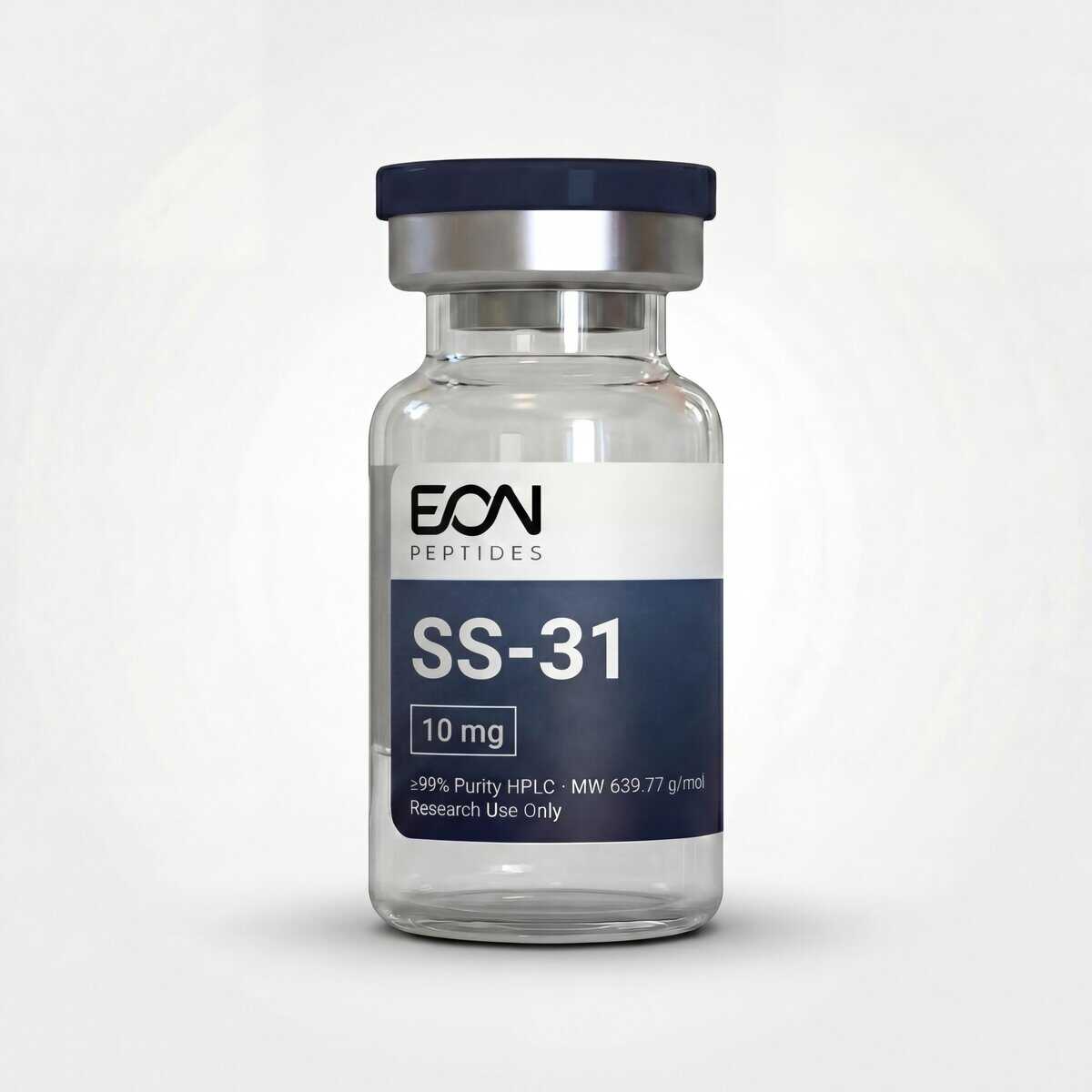
| Available sizes | 10mg |
How it works
-
Cardiolipin Binding
Inner Mitochondrial Membrane Stabilization
SS-31 selectively concentrates in the inner mitochondrial membrane (IMM) where it binds to cardiolipin - a unique phospholipid exclusive to mitochondria. This interaction stabilizes cardiolipin's structure, which is critical for cristae morphology and the assembly of electron transport chain (ETC) supercomplexes.
- Binds cardiolipin at the inner mitochondrial membrane
- Stabilizes ETC supercomplex assembly
- Cristae morphology measured in damaged mitochondria
-
ROS Scavenging
Mitochondrial Reactive Oxygen Species Reduction
The dimethyltyrosine (Dmt) residue within SS-31's sequence carries antioxidant capacity concentrated at the site of ROS generation. In preclinical models of ischemia-reperfusion injury, mitochondrial superoxide production and electron transport chain efficiency were measured following SS-31 administration.
- Dmt residue carries targeted antioxidant capacity
- Lower mitochondrial superoxide generation measured
- Preserves electron transport chain efficiency
-
ATP Synthesis
Bioenergetic Function
Cardiolipin integrity and oxidative damage to ETC complexes are measured alongside the proton gradient across the IMM and ATP synthase function. In aged rodent models, mitochondrial membrane potential and ATP production rates were recorded.
- Mitochondrial membrane potential measured
- ATP synthase coupling efficiency measured
- Mitochondrial respiration measured in aged tissue models
What the research shows
-
Cardiology Research
Heart Failure
Elamipretide is the research designation for SS-31. Mitochondrial bioenergetics in cardiac tissue models is the focus of research on this compound.
-
Ischemia Models
Reperfusion Injury
In rodent models of myocardial and renal ischemia-reperfusion injury, infarct size and organ function markers were measured following SS-31 exposure.
-
Aging Biology
Mitochondrial Aging
In aged rodents, skeletal muscle mitochondrial function, ATP production rates and physical performance markers were measured following SS-31 administration.
-
Nephrology Research
Renal Models
Renal ischemia models are a further area of research interest for SS-31, including kidney injury markers and renal function measures.
Specification
| Also Known As | Elamipretide, MTP-131, Bendavia |
|---|---|
| Sequence | D-Arg-Dmt-Lys-Phe-NH2 |
| Molecular Weight | 638.8 Da |
| Molecular Formula | C32H49N9O5 |
| Target | Cardiolipin / Inner Mitochondrial Membrane |
| Mechanism | Cardiolipin binding; ROS scavenging; ETC stabilization |
| Form | Lyophilized powder (5mg) |
| Purity | ≥99% (HPLC verified) |
| Testing | Third-party HPLC, Mass Spec, Endotoxin |
| Storage | -20°C for long-term stability |
| Solubility | Soluble in water |
| COA | Included with every order |
How it's tested
Every lot of SS-31 released to the catalog carries a third-party certificate of analysis. 4 documented lots are on file for this compound, with reported HPLC purity from 99.71% to 99.89% (mean 99.78%), issued by Accurate Test Labs. 3 of 4 certificates record identity as confirmed.
- Documented lots
- 4
- Reported purity
- 99.71% to 99.89%
- Mean purity
- 99.78%
- Issuing labs
- Accurate Test Labs
- 2026-09-03 Lot SS-090226-10Accurate Test Labs 99.71% View certificate
- 2026-08-18 Lot 8X0MWAAccurate Test Labs 99.73% View certificate
- 2026-08-03 Lot V0124NAccurate Test Labs 99.79% View certificate
Frequently asked questions
What is SS-31 and what makes it unique?
SS-31 (also known as Elamipretide, MTP-131, or Bendavia) is a synthetic aromatic-cationic tetrapeptide (D-Arg-Dmt-Lys-Phe-NH2) developed by Hazel Szeto and Peter Schiller, giving it the "SS" designation. Unlike most antioxidants it does not act on ROS systemically - it concentrates selectively at the inner mitochondrial membrane, binding cardiolipin within the architecture of the electron transport chain. That targeting is why it is studied across cardiac, renal and ageing biology.
What is cardiolipin and why does SS-31's binding to it matter?
Cardiolipin is a phospholipid found almost exclusively in the inner mitochondrial membrane. It plays a structural role in organizing the electron transport chain supercomplexes (respirasomes) that drive ATP production. When mitochondria are damaged or aged, cardiolipin becomes oxidized (peroxidized), and cristae disorganization and ETC function are affected. SS-31 binds cardiolipin with high affinity; lower peroxidation and ETC supercomplex assembly are measured alongside, which is the proposed basis for its bioenergetic readouts.
What is SS-31's regulatory status?
Elamipretide, the research designation for SS-31, is not approved by the FDA or any regulatory agency for any indication. It remains an investigational compound, and this material is supplied exclusively for in vitro laboratory research.
How does SS-31 get into mitochondria?
SS-31's uptake into mitochondria is independent of the mitochondrial membrane potential, unlike many other mitochondria-targeted compounds (e.g., MitoQ). This is significant because damaged or depolarized mitochondria - the ones most in need of intervention - can still accumulate SS-31. The peptide's alternating aromatic and cationic residues facilitate spontaneous partitioning into the negatively charged inner mitochondrial membrane.
What are the main research models in which SS-31 has been studied?
SS-31 has been studied in: ischemia-reperfusion injury models (cardiac, renal, cerebral); diet-induced and genetic models of heart failure; aged skeletal muscle function studies; models of mitochondrial disease (Barth syndrome); neurodegenerative disease models; and various oxidative stress paradigms. Human clinical data exist for cardiac and renal applications.
How should SS-31 be stored and handled for research?
Store lyophilized SS-31 at -20°C, protected from light, and minimize freeze-thaw cycles. SS-31 is water-soluble and does not require DMSO for dissolution, which simplifies its handling in aqueous research systems. Always refer to published study protocols for specific concentration and vehicle guidance.
Selected preclinical literature
8 published studies on SS-31, limited by rule to animal models and cell-based (in vitro) work indexed in PubMed. Human trials, case reports and literature overviews are excluded. Titles appear as published and each links to its PubMed record; the list was resolved against PubMed on 2026-10-12. A listing describes what a study examined, not a property of the material supplied.
-
Rats model and in vitro
Targeting Mitochondrial Dysfunction With Elamipretide (SS-31) Improves Skeletal Muscle Performance in a HFpEF Rat Model
Circulation. Heart failure, 2026. PubMed PMID 42290373 · doi:10.1161/CIRCHEARTFAILURE.126.014397
-
Rats and Mice model and in vitro
SS-31 improves post-cardiac arrest brain injury by inhibiting microglial ferroptosis and polarization
Neurotherapeutics : the journal of the American Society for Experimental NeuroTherapeutics, 2026. PubMed PMID 41136322 · doi:10.1016/j.neurot.2025.e00772
-
Rats model and in vitro
SS-31@Fer-1 Alleviates ferroptosis in hypoxia/reoxygenation cardiomyocytes via mitochondrial targeting
Biomedicine & pharmacotherapy = Biomedecine & pharmacotherapie, 2025. PubMed PMID 39848110 · doi:10.1016/j.biopha.2025.117832
-
Mice model and in vitro
Aging, mitochondrial dysfunction, and cerebral microhemorrhages: a preclinical evaluation of SS-31 (elamipretide) and development of a high-throughput machine learning-driven imaging pipeline for cerebromicrovascular protection therapeutic screening
GeroScience, 2025. PubMed PMID 40169521 · doi:10.1007/s11357-025-01634-5
-
Swine model
Elamipretide mitigates ischemia-reperfusion injury in a swine model of hemorrhagic shock
Scientific reports, 2023. PubMed PMID 36934127 · doi:10.1038/s41598-023-31374-5
-
Mice model
Elamipretide alleviates pyroptosis in traumatically injured spinal cord by inhibiting cPLA2-induced lysosomal membrane permeabilization
Journal of neuroinflammation, 2023. PubMed PMID 36609266 · doi:10.1186/s12974-023-02690-4
-
Mice model and in vitro
Intermittent treatment with elamipretide preserves exercise tolerance in aged female mice
GeroScience, 2023. PubMed PMID 36840897 · doi:10.1007/s11357-023-00754-0
-
Mice model
Elamipretide effects on the skeletal muscle phosphoproteome in aged female mice
GeroScience, 2022. PubMed PMID 36322234 · doi:10.1007/s11357-022-00679-0
Related monographs
For laboratory research use only. Not a drug, supplement, or medical product; not for human or animal use. All findings referenced are from published preclinical/laboratory research.