
The molecule, in three dimensions
- Heavy atoms
- 75
- Bonds
- 78
- Composition
- C50 N14 O11
- Rings
- 3
- Metal centre
- None
- Chain length
- 7 residues
Every heavy atom is placed from the sequence with ideal bond lengths and angles, so the connectivity is exact. The pose is idealised, an extended chain, and is not a measured conformation. Identity for the lot in stock is confirmed by LC-MS on its certificate.
Molecular data
| Molecular formula | C50H68N14O10 |
|---|---|
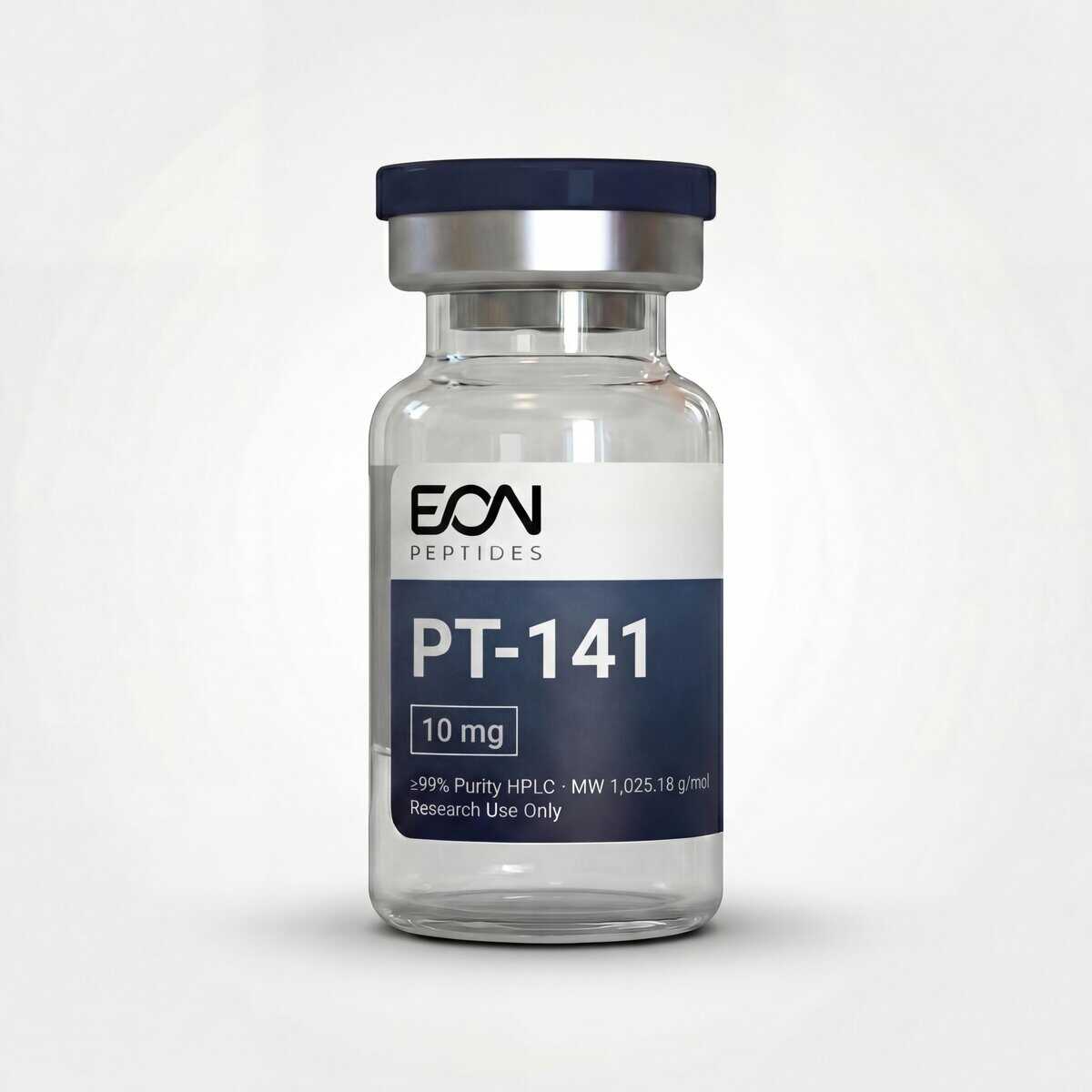
| Molecular weight | 1025.18 Da |
| Sequence | Ac-Nle-cyclo[Asp-His-D-Phe-Arg-Trp-Lys]-OH |
| Sequence length | 7 residues |
| CAS / identifier | Bremelanotide |
| Physical form | Lyophilized powder |
| Available sizes | 10mg |
How it works
-
MC4R Agonism
Melanocortin-4 Receptor Activation
PT-141 (bremelanotide) acts as a non-selective melanocortin receptor agonist with high affinity for MC3R and MC4R. Activation of MC4R in the central nervous system is associated with the compound's observed effects on arousal pathways in preclinical and clinical research.
- High-affinity binding at MC3R and MC4R
- Central nervous system activity via hypothalamic pathways
- Distinct mechanism from PDE5 inhibitors (no vascular action)
-
Central Pathways
Hypothalamic Signaling Modulation
Research reports PT-141 acts centrally through hypothalamic and limbic system circuits, influencing dopaminergic and serotonergic pathways. This central mechanism of action distinguishes it from peripherally-acting compounds.
- Modulates dopaminergic neurotransmission
- Acts on hypothalamic arousal circuits
- Distinct from peripheral vascular mechanisms
-
Alpha-MSH Analog
Cyclic MSH Derivative
PT-141 is a synthetic cyclic analog of alpha-melanocyte stimulating hormone (α-MSH). Its cyclic structure carries greater metabolic stability and narrower receptor selectivity than its linear precursor. The compound is derived from Melanotan II via hydrolysis of the cyclic lactam ring.
- Cyclic structure raises metabolic stability
- Derived from Melanotan II via chemical modification
- Narrower selectivity profile vs. linear α-MSH
What the research shows
-
Melanocortin Signalling
Central Arousal Models
Bremelanotide is the research designation for PT-141. Melanocortin-pathway signalling in sexual-function models is the focus of research on this compound.
-
Receptor Pharmacology
Melanocortin System
Research into MC3R and MC4R signaling cascades, including downstream cAMP production and modulation of hypothalamic neuropeptide systems involved in energy homeostasis and arousal.
-
Sexual Function Models
MC4R Pathway Models
Central MC4R signalling is studied as a pathway distinct from the NO/cGMP cascade in sexual-function models.
-
Neuropharmacology
CNS Mechanism Studies
Investigation of central nervous system melanocortin receptor distribution, downstream signaling via Gs-coupled cAMP pathways, and interaction with dopaminergic reward circuitry in preclinical models.
Specification
| Chemical Name | Bremelanotide |
|---|---|
| Sequence | Ac-Nle-cyclo[Asp-His-D-Phe-Arg-Trp-Lys]-OH |
| Molecular Weight | 1025.18 Da |
| Molecular Formula | C₅₀H₆₈N₁₄O₁₀ |
| Form | Lyophilized powder |
| Purity | ≥99% (HPLC verified) |
| Testing | Third-party HPLC, Mass Spec, Endotoxin |
| Storage | -20°C for long-term stability |
| Solubility | Water-soluble |
| COA | Included with every order |
How it's tested
Every lot of PT-141 released to the catalog carries a third-party certificate of analysis. 5 documented lots are on file for this compound, with reported HPLC purity from 99.91% to 99.95% (mean 99.92%), issued by Accurate Test Labs and Freedom Diagnostics. 2 of 5 certificates record identity as confirmed.
- Documented lots
- 5
- Reported purity
- 99.91% to 99.95%
- Mean purity
- 99.92%
- Issuing labs
- Accurate Test Labs, Freedom Diagnostics
- 2026-09-03 Lot PT-090226-10Accurate Test Labs 99.92% View certificate
- 2026-08-18 Lot Z7HUJWAccurate Test Labs 99.91% View certificate
- 2026-05-11 Lot Auth2605110192Freedom Diagnostics 99.91% View certificate
Frequently asked questions
What is PT-141 (Bremelanotide)?
PT-141, also known as bremelanotide, is a synthetic cyclic heptapeptide and analog of alpha-melanocyte stimulating hormone (α-MSH). It acts as an agonist at melanocortin receptors, particularly MC3R and MC4R. The compound was developed from Melanotan II. A separate pharmaceutical formulation has since been approved for one clinical indication; the research-grade PT-141 sold on eonpeptides.com is not that product.
How does PT-141 differ from PDE5 inhibitors like sildenafil?
PT-141 has a different mechanism from PDE5 inhibitors (like Viagra/Cialis). PDE5 inhibitors act peripherally on blood flow via the nitric oxide/cGMP pathway. PT-141 acts centrally at melanocortin receptors in hypothalamic and limbic circuits, with dopaminergic neurotransmission as the studied pathway rather than vascular mechanisms.
Is PT-141 FDA approved?
An approved pharmaceutical formulation of bremelanotide exists for one clinical indication. The research-grade PT-141 sold on eonpeptides.com is not that product: it is for in vitro research purposes only and is not the approved pharmaceutical product.
What receptors does PT-141 bind to?
PT-141 binds to multiple melanocortin receptor subtypes. It has highest affinity for MC4R and MC3R, with lower affinity for MC1R, MC2R, and MC5R. MC4R activation in the hypothalamus is believed to be the primary driver of its effects on arousal-related circuits based on receptor knockout studies and pharmacological profiling research.
How is bremelanotide characterised in melanocortin research?
Bremelanotide is a melanocortin receptor agonist with activity at MC4R, studied for central rather than vascular mechanisms of sexual-function signalling. This material is supplied for in vitro laboratory research only and is not offered for any human use.
How should research-grade PT-141 be stored?
Lyophilized PT-141 should be stored at -20°C for long-term stability and protected from light. Avoid repeated freeze-thaw cycles, which can degrade peptide integrity.
Related monographs
For laboratory research use only. Not a drug, supplement, or medical product; not for human or animal use. All findings referenced are from published preclinical/laboratory research.